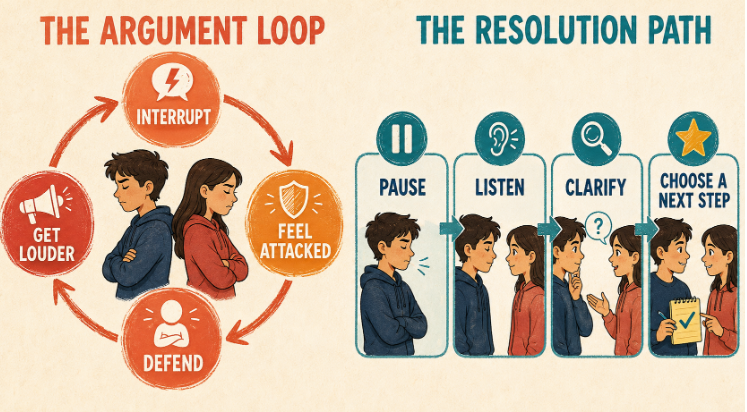
When Two People Are Sure They Are Right
The ball goes out. You are sure the other person touched it last. They are equally sure you did. Within about five seconds, a game that was going perfectly well has become an investigation involving several witnesses, two completely different versions of history and absolutely no video replay.
Conflict can happen quickly in games and physical activities because people are making decisions, following rules, cooperating and competing at the same time. Add some excitement, frustration or a close score, and a small disagreement can suddenly feel surprisingly important. Conflict itself is not necessarily the problem. What we do once it begins is where the skill comes in.

Two people can experience the same event differently
One of the difficult things about conflict is that we experience it from inside our own point of view. You know what you saw, what you intended and how the other person's actions affected you. What you do not automatically know is what they saw, what they intended or what information they were using.
That means two people can disagree without either person deliberately lying. Attention is selective, events happen quickly, and our brains constantly interpret incomplete information. In a fast moving game, you may notice the hand that hit your arm while the other person notices that they were looking at the ball. You experienced the contact. They experienced an attempt to make a play.
Now add emotion.
When something feels unfair, embarrassing or threatening, the body's stress response can increase. Your heart may beat faster, muscles can tense and attention can become more focused on whatever seems important at that moment. Under enough stress, it can also become harder to think flexibly and consider several explanations at once.
That creates an interesting problem. The moment when another person's perspective might be most useful can be the exact moment when you are least interested in hearing it.
Deal with the problem, not the person
Suppose someone makes a rough play and you become angry. There is a big difference between saying, “That contact was too hard,” and saying, “You're such an idiot.”
The first statement identifies a problem that can potentially be solved. The second turns the other person into the problem. Once people start defending themselves rather than discussing what happened, the original disagreement can disappear underneath a brand new argument.
This is one reason confronting a problem does not have to mean confronting someone aggressively. It can mean being willing to address what happened instead of pretending it did not matter, complaining about the person to everyone else or waiting until the frustration comes out somewhere completely unrelated.
Sometimes being assertive is part of that. Assertiveness means clearly expressing what you think, need or are uncomfortable with while still respecting the other person. You can say, “I don't think that was safe,” or “I understand your point, but I don't agree,” without attacking anyone.
Listening is more than becoming temporarily silent
Most of us can remain quiet while another person speaks. That does not necessarily mean we are listening.
During conflict, it is remarkably easy to spend the other person's speaking time preparing the excellent response that will finally demonstrate why they are wrong. Active listening asks for something different. You are trying to understand what the person means before deciding what you think about it.
That might involve asking a question, checking what you heard or saying, “So you thought the play had already stopped?” Sometimes that one piece of information changes the entire disagreement. Sometimes it changes nothing, but at least you are now disagreeing with what the person actually thinks rather than what you assumed they thought.
And there is an important distinction here. Understanding someone's perspective does not require agreeing with it.
You might understand exactly why someone made a decision and still think it was the wrong decision. You can appreciate another perspective without giving up your own. In fact, knowing both perspectives usually gives everyone more information for solving the actual problem.
What is the argument really about?
People often get stuck defending their positions.
“I was there first.”
“No, I was.”
“Yes, I was.”
That conversation has limited potential for scientific advancement.
It can help to look underneath the positions. Maybe one person is frustrated because they have barely had a turn. Maybe the other thought the group had already agreed on the roles. Perhaps the real problem is that nobody actually decided how turns would work.
Once the underlying problem becomes clearer, there may be several possible solutions that nobody could see while everyone was busy proving who was right.
Sometimes an apology is part of solving it
There will also be times when you realize that you contributed to the problem.
A useful apology does more than produce the word sorry. It recognizes what you did and the effect it had. “I shouldn't have pushed you when I got frustrated” takes responsibility in a way that “Sorry you got upset” does not.
Apologizing also does not guarantee that everything instantly returns to normal. The other person may still be angry or need some time. An apology is something you can offer. Forgiveness is not something you can demand.