
Safety Is Something You Practice
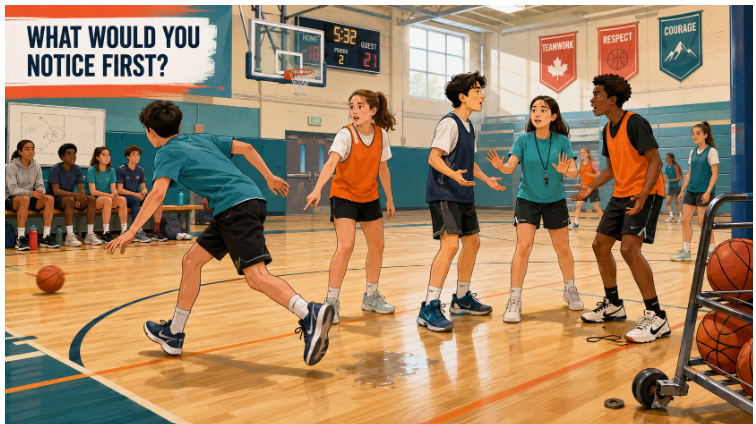
You Have Ten Seconds. What Do You Notice?
The basketball game has been going for less than five minutes, but several things are already happening at the same time. A ball rolls toward the next court, one player has an untied shoelace, and there is a wet patch near the basket that nobody has mentioned. At the same time, two players are arguing about a foul, and their voices are becoming louder. The teacher has not blown the whistle, so the game could continue if everyone simply keeps playing. However, each of these details could affect the safety of the activity if nobody responds. The important question is not only whether the game has officially been stopped but whether someone has noticed a reason that it should pause. Safety often begins in the few seconds between noticing a possible problem and deciding what to do about it.
Choice One: Keep Playing or Say Something?
Imagine that the ball is still live and your team has a good chance to score, but you can clearly see the wet patch near the basket. One choice is to keep playing and assume that somebody else will probably notice it. Another choice is to call for a pause and point out the slippery area before anyone runs across it. Continuing may keep the game moving for a few more seconds, but it could also send another player directly toward a risk they have not seen. Pausing interrupts the activity, but only long enough for the surface to be checked and cleaned. Once the area is safe, everyone can return to the game without having to avoid a hidden problem. Speaking up is therefore not ruining the activity because it can help the activity continue with less unnecessary risk.
Choice Two: Use It Anyway?
After the wet patch has been cleaned, imagine that you notice a loose wheel on the basketball rack. The rack can still move, so it may be tempting to assume that it will probably be fine for the rest of the activity. However, equipment is safest when people check its condition and use it only in the way it was designed to be used. A loose, cracked, torn, or unstable piece of equipment can behave differently once people begin moving it or applying force. The fact that it worked a moment ago does not guarantee that it will continue working safely. If something looks damaged, the safer response is to stop using it and tell the person responsible for the equipment. Hoping that a problem will not matter is very different from checking whether the equipment is actually safe to use.
Your Behaviour Changes Someone Else's Risk
Using equipment properly seems pretty straightforward. A racquet is for hitting a shuttle or ball. A stick is for playing the activity it was designed for. Gym equipment has a particular way it is meant to be used.
But there is another part that is easy to miss. You can be using a piece of equipment correctly and still need to pay attention to the people around you. Before swinging something, throwing something or moving quickly into a space, you have to notice who else might be affected by what you are about to do.
That gives us a bigger way of thinking about safety. Your behavior changes the environment that everyone else is moving through. If you use equipment unpredictably, someone else has to react to that unpredictability. If you use it properly and pay attention to the people around you, you make the situation more predictable for everyone.
Safety in a group is shared.
Rules Do More Than Decide Who Wins
Rules can sometimes feel like a collection of things someone else decided you are not allowed to do. But many rules have another purpose. They make people's behavior more predictable.
Think about what would happen if everyone in a game quietly invented their own rules. One person decides contact is allowed. Someone else thinks it isn't. Nobody agrees on where people can move, when play stops or what happens when the ball goes out. Even people who are trying to play safely would have trouble because they would not know what everyone else was about to do.
The same idea works outside physical activity. A green traffic light cannot physically prevent another driver from entering the intersection. What makes the system work is that people share an understanding of what the lights and road rules mean. Following shared rules gives everyone a better chance of anticipating what other people will do.
When the Ball Is No Longer the Problem
Then there is conflict.
A ball lands close to a line. One person says out. Another says in. Someone raises their voice, someone else answers a little louder, and within twenty seconds the location of the ball has somehow become the least important part of the conversation.
There is some biology behind why disagreements can escalate so quickly. When your brain decides something is threatening, unfair or socially important, your stress response can begin to rise. Attention can narrow, emotions can become stronger and the first response that arrives may not be the response you would choose if you had more time to think.
You have already been practising another skill that matters here: noticing what is happening and creating enough space to choose what comes next. In a disagreement, that might mean lowering your voice, listening to the other person's explanation, going back to an agreed rule, asking someone else to help settle the problem or taking a moment before responding. Conflict resolution is not about pretending you agree. It is about dealing with disagreement without allowing the disagreement to create a bigger problem.
And that makes conflict resolution part of safety, not just good manners.
The Game Is a Place to Practise
Knowing all of this does not mean you will always do it perfectly. That is exactly why practice matters.
Every physical activity gives you small opportunities to practise checking the space around you, using equipment responsibly, following shared rules, noticing changing risk and dealing with disagreement before it escalates. Different activities create different situations, so you gradually get practice making those decisions under different conditions and with different people.
Something else is happening at the same time. You are practising behaviours that are useful far beyond a gym, field, court, trail or playground.
Life contains plenty of shared spaces, equipment, rules, unexpected situations and people who will occasionally disagree with you. Eventually those situations might involve a workplace, a vehicle, a kitchen, a laboratory, a hiking trail or something you have not encountered yet. The details will change, but many of the decisions underneath them will be surprisingly familiar.
That does not mean practising safe behaviour during physical activity automatically makes you good at handling every situation in life. Skills do not magically jump from one situation to another. Part of developing a skill is learning to recognize where else it might be useful.
So the next time you stop because someone has fallen, check the space before using equipment, follow a rule that protects other people or help settle a disagreement before it gets bigger, notice what you actually just practised.
You were not only playing safely.
You were practicing how to be someone other people can be safe around.