
Why Does the First Five Minutes Feel So Different?
How warming up, cooling down and transitions prepare your body and brain
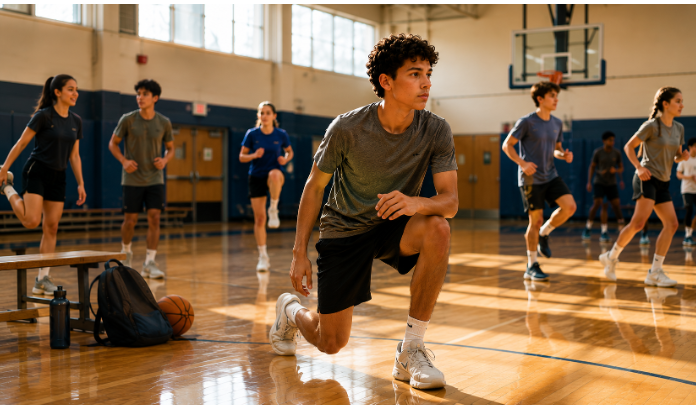
You can be standing completely still one minute and chasing someone across a gym, climbing a hill, dancing, skating, running for a bus or playing a pickup game a few minutes later. Your brain may have decided to go from zero to full speed almost instantly. Your muscles, joints, heart and lungs have a little more work to do.
That is really what a warm-up is for. It is a transition between what your body was doing and what you are about to ask it to do. A cool-down provides another transition at the other end. Neither needs to be complicated, but there is considerably more happening inside you than the name “warm-up” suggests.
What Does Getting “Warm” Actually Change?
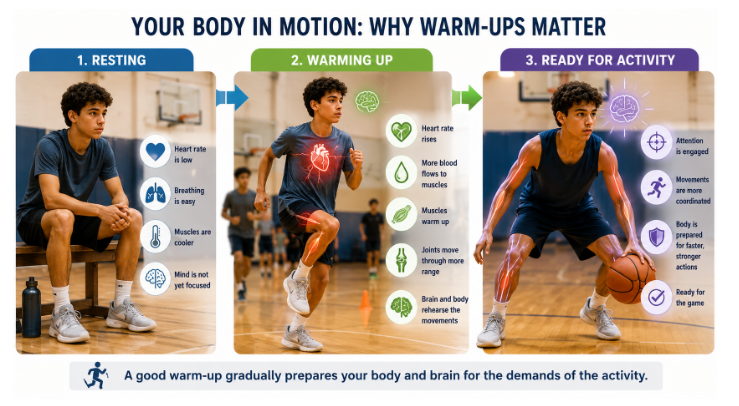
As you begin moving, your working muscles need more energy. Your heart rate rises, more blood is directed toward active muscles, and your breathing increases so that oxygen can move from your lungs into your blood and eventually reach the cells that are using it. Blood vessels supplying active tissue widen, helping increase blood flow where it is needed.
Muscle temperature also begins to rise. Warmer muscles can contract and relax more quickly, and increasing temperature can influence the mechanical properties of muscles and tendons. Movement through progressively larger ranges can also temporarily increase the range of motion available around a joint. In other words, you are not just “loosening up.” You are changing the conditions under which your muscles, tendons and joints are about to work.
There is an important distinction here. Stretching and warming up are not necessarily the same thing. Research increasingly supports active, dynamic warm-ups that gradually increase movement and include movements related to the activity that follows. Simply holding a few long stretches before explosive activity does not produce all the physiological changes of an active warm-up and, depending on how it is done, can temporarily reduce some types of muscle performance.
A Warm Up Should Match the Activity
A useful warm up becomes more specific as the body gets closer to the demands of the activity. Before soccer, you might begin with easy movement and gradually add changes of direction, balance, acceleration, and movements involving the ball. Volleyball would require a different pattern because jumping, landing, reaching, and rapid reactions are especially important. A runner may focus more on gradually increasing movement speed and preparing the legs for repeated forward motion. The purpose is not to perform the exact same routine before every possible activity. Instead, the warm up should help the body rehearse movements and forces that are likely to appear later. This makes preparation more connected to what you are actually about to do rather than treating warming up as a separate collection of random exercises.
Your Nervous System Is Warming Up Too
A movement begins before a muscle moves. Your brain and spinal cord have to send signals through motor nerves to activate particular groups of muscle fibres, while sensory information continually returns to your nervous system about body position, balance, speed and force. Your brain uses that information to coordinate what happens next.
That makes a good warm-up partly a rehearsal. If you are about to change direction quickly, jump, throw, lift, skate or move around other people, gradually practising related movements gives your nervous system an opportunity to coordinate those movements before greater speed and force are added. Balance, timing and control matter because your muscles rarely work alone. Your brain has to organize many muscles around several joints into one coordinated movement.
There can be a mental transition as well. A few minutes earlier, your attention might have been on a conversation, an assignment or whatever was happening on your phone. Beginning to move shifts attention toward your body, your surroundings and the activity ahead. You start noticing where other people are, how your body feels and what you are about to do.
That is why warming up can make sense whether you are preparing for a league game, PE class, a pickup activity with friends or something you are doing alone. The exact warm-up should change with the activity. Preparing for a walk does not require the same routine as preparing for repeated sprinting and rapid changes of direction.
Proprioception: Knowing Where Your Body Is
One important part of brain and body communication is proprioception, which is your ability to sense where different parts of your body are without constantly looking at them. Proprioception helps you recognize that your knee is bent, your weight has shifted, or your foot has landed slightly away from where you expected. This information is important for balance, movement control, and making quick adjustments. Research shows that proprioceptive training can improve body position sensing and motor performance. During a warm up, balance activities, controlled movements, and activity specific actions can give this system useful practice. A player may begin noticing how their body feels during changes of direction or landing before those movements happen at full speed. This helps explain why warming up can feel like your movements are becoming more coordinated as the activity begins.
What a Useful Warm Up Might Include
There is no single warm up that is perfect for every person and every activity. The useful components depend on what you are preparing to do, how intense the activity will be, and what movements it requires. A good sequence usually begins at a manageable level and gradually becomes more connected to the activity ahead. It should prepare rather than exhaust you, which means the goal is readiness rather than proving how hard you can work before the game begins. Different sports and activities may emphasize different components, but several ideas appear often in effective preparation. A warm up might include:
Easy movement that gradually raises heart rate and breathing.
Joint movements that prepare the ranges needed in the activity.
Balance and movement control exercises.
Gradual changes of speed and direction.
Practice with important skills or equipment used in the activity.
Short activity specific movements that prepare attention, timing, and coordination.
What Cooling Down Can and Cannot Do
Cooling down is sometimes described as though it can prevent every sore muscle or protect people from all injuries after exercise. Scientific evidence does not strongly support the idea that an active cool down automatically prevents soreness or injuries. Its benefits are more limited and can depend on the activity, intensity, and individual. This does not make cooling down pointless because gentler movement can still provide a gradual transition away from harder effort. Stretching or mobility work may also be useful when maintaining or developing range of motion is one of your goals. The important point is to avoid giving the cool down magical powers that research does not support. A useful recovery routine should be understood for what it can realistically provide rather than for claims that sound impressive but are not well supported.
There Is a Bigger Idea Hiding in All of This
Warm-ups and cool-downs make sense outside physical activity because they represent two useful transitions: preparing before doing and reflecting after doing.
Before starting something important, you can ask yourself what you are about to do, what you will need and what might make it go better. Before a school presentation, that might mean looking over the first few lines, getting your materials ready and settling your attention before you begin. Before working on something difficult, it might mean deciding what you are trying to accomplish rather than opening five tabs and hoping one of them knows.
There is an equivalent cool-down afterward. What worked? What did not? Is anything unfinished? What would make tomorrow easier? Athletes and teams review performances for exactly this reason, but the same process can work after a group project, a difficult conversation, a day at school or eventually a day at work.
The interesting part is that the middle often gets most of our attention. We think about the game, the assignment, the performance or the job that has to be done. Yet what happens before can influence how ready we are to begin, and what happens after can help us learn from what just happened and prepare for what comes next.
Your body does not have an on-off switch. Neither, as it turns out, does much of the rest of life.