
Think, Move, Adapt: The Game Is Always Changing
Imagine you are playing a small sided soccer game in PE. You receive the ball and immediately start running toward the goal because that worked perfectly thirty seconds ago. There is only one tiny problem: this time, two defenders are already waiting for you like they received a calendar invitation. You keep charging forward, lose the ball, and wonder why your brilliant plan suddenly stopped being brilliant. The answer is simple: games change from moment to moment, so good players do not just move. They notice what is happening, make a decision, and then move.
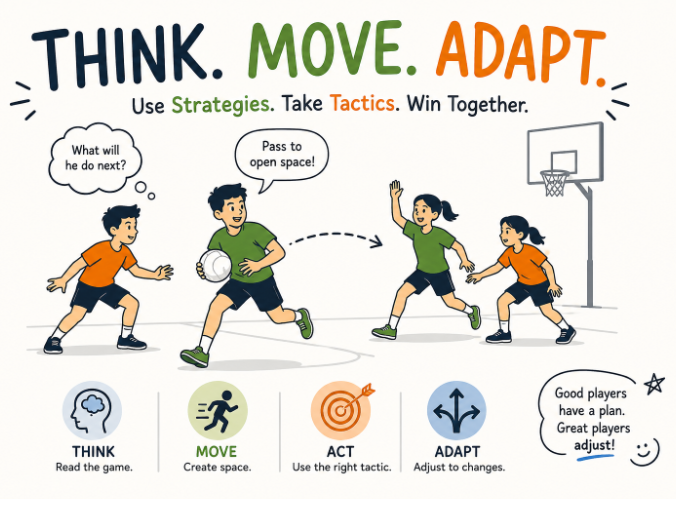
A Strategy Is the Big Plan
Before a game begins, a team might decide on a strategy, which is the bigger plan for how it wants to play. In basketball, the strategy might be to keep possession and create open shots instead of rushing toward the basket every time. In badminton, it might be to move an opponent around the court until an open space appears. A strategy gives you direction, but it cannot predict every bounce, pass, opponent, or surprise. That is why players need to adjust the plan while the activity is happening.
Tactics Are What You Do Right Now
Tactics are the specific actions and in the moment decisions that help you carry out a strategy. Suppose your basketball team's strategy is to keep possession, but a defender suddenly blocks your path. Your tactic might be to pivot, pass backward, fake a pass, or move into a new space. None of those choices changes the team's larger goal, but one may work better in that exact moment. Think of strategy as deciding where the road trip is going and tactics as choosing which turn to take when a goat is standing in the road.
Quick check: Which of these sound like tactics?
• Changing direction when an opponent closes the space.
• Passing to an open teammate instead of forcing a shot.
• Moving closer to the net when you expect a short return.
• Slowing down briefly so you can see what options are available.
Your Movement Is a Decision
Movement strategies are really about making informed choices about how and where to move as conditions change. Picture a game of tag where you are sprinting toward an open corner, but another player suddenly appears there. You could keep running and hope they politely disappear, but that is not a particularly strong strategy. Instead, you might slow down, change direction, use another player as a screen, or move toward a different open space. Your movement changes because the conditions changed, and that ability to adapt is useful in almost every physical activity.
Anticipation Is Not Mind Reading
Anticipating means using clues to predict what might happen next, then getting ready to respond. In volleyball, you might notice that a player is facing toward the left side of the court before serving. In soccer, you might see an opponent glance toward a teammate just before making a pass. You are not magically reading minds; you are evaluating body position, space, speed, patterns, and what has happened earlier in the game. Sometimes your prediction will be wrong, but practising anticipation helps you react earlier and make better decisions.
The Notice, Decide, Move Challenge
The next time you play a game, try a simple three step challenge instead of moving on autopilot. First, notice one useful clue, such as an open space, an opponent's position, or where your teammates are moving. Next, decide what action gives you the best chance of helping your team or completing the activity. Then move and watch what happens, because your first choice may need to change again two seconds later. The goal is not to make the perfect decision every time; the goal is to practise seeing, thinking, and adapting.
Ask yourself during play:
• What changed?
• What clue did I notice?
• What are my options?
• Which movement or tactic fits this moment?
• Did it work, or should I adjust?
Good Players Keep Updating the Plan
Practicing tactics and strategies is not about memorizing one correct move for every game. It is about becoming better at noticing what is happening and choosing a response that fits the situation. A pass that was smart one minute ago may be risky now, and a space that was open may disappear before you reach it. The more you practise evaluating, anticipating, and adapting, the less likely you are to freeze when a game changes unexpectedly. So next time the defenders appear to have received that calendar invitation, do not panic. Look up, update the plan, and make your next move.