
Are You Actually Included?
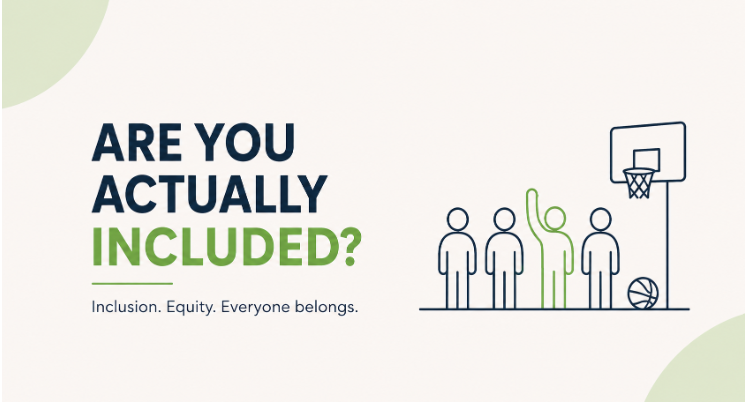
You are on the team. You are standing on the court. Technically, you are playing. But ten minutes later, you have touched the ball twice, the same three people are doing almost everything, and you are becoming surprisingly familiar with one section of the gym floor. Are you actually included in the game?
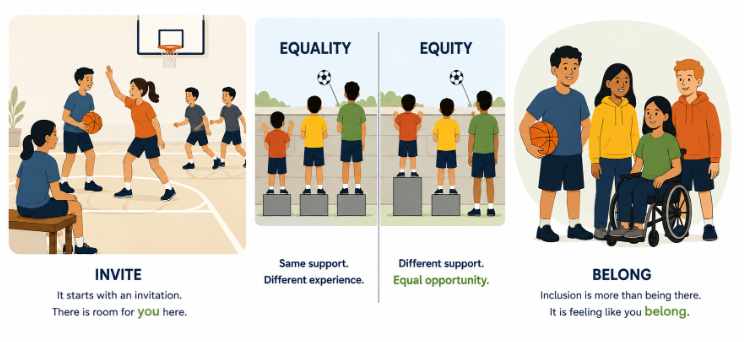
Being included means more than being allowed to stand somewhere. It means having a meaningful chance to participate, contribute and feel like you are part of what is happening. That can start with something very simple: an invitation. When someone asks, “Do you want to join us?” they are also sending another message: there is room for you here.
That matters because joining a group is not always easy. Maybe everyone else already knows the game. Maybe you are not sure whether they want another person, or you have never tried the activity before. You could walk over and ask to join, but now you have to make the first move and risk hearing no. An invitation removes some of that uncertainty.
But inviting someone is only the beginning. Suppose they join and nobody passes to them, listens to their ideas or gives them a real way to contribute. They have been invited, but they may not feel included. Being present and belonging are not the same thing.
This is where equity becomes important. Equity means giving people a fair opportunity to participate. It does not necessarily mean giving everyone exactly the same thing, because people do not arrive at an activity with exactly the same experience, abilities, confidence or interests.
Consider a game where everyone gets exactly the same rules, equipment and amount of space. That sounds fair. But then two experienced players control the ball almost the entire time while several other people barely become involved. Everything may have been equal, but the experience was not very equitable.
Equity does not mean everyone must score the same number of points or that every activity needs to be made easier. Challenge is part of learning, and people are allowed to become better at something after years of practice. Instead, equity asks a different question: Does everyone have a reasonable opportunity to take part?
Sometimes one small change can make a surprisingly large difference. A group might change the size of the playing area, use different equipment, create smaller teams, add different roles or change a rule so more people become involved. The goal is not to make everyone identical. It is to notice when something is unnecessarily keeping someone on the outside and consider whether it can change.
The game doesn't end at the gym door
Now take the basketball away.
A group is working on a class project and one person never gets asked what they think. Someone arrives at lunch and every seat at the table seems to have an invisible “reserved” sign on it. A new student is standing nearby while everyone else talks about people and events they already know. Someone joins a club but quickly discovers that a small group makes almost every decision.
The details have changed, but the question hasn't: Is everyone who is there actually included?
This is why learning about inclusion through physical activity can matter far beyond physical activity. Games make participation unusually easy to see. You can notice who receives the ball, who gets a turn and who spends most of the activity watching. Outside the gym, exclusion can be much quieter.
You can also do something about it. Ask the quiet person what they think during a group project. Make room at the table. Explain enough of the conversation that someone new can enter it. Invite someone along rather than assuming they would not be interested.
That does not mean everyone has to become friends with everyone else or that every person must be included in every private event. Inclusion is not forced friendship. It means becoming better at noticing when someone should have a reasonable opportunity to participate but something about the situation is unnecessarily shutting them out.
There is another important part of equity: do not assume you know what somebody else needs. Someone may want an invitation, some information, a different way to participate or no help at all. Sometimes the smartest question is simply, “What would help?” Then listen to the answer.
Physical activity gives you a place to practise seeing all of this. Notice who is participating, who is being heard, who has a meaningful role and who seems to be disappearing from the activity. Then start noticing the same things elsewhere.
Because eventually there is no basketball to pass.
There is a conversation, a classroom, a team, a workplace, a community or a person standing just outside a group wondering whether there is room for them. Learning to notice that person, and sometimes being the person who opens the space, is what makes inclusion much bigger than a game.