
Teaching Games for Understanding: Developing Physical Literacy Through Tactical Learning
You are playing basketball and notice an open teammate near the basket. Later, in badminton, you notice an empty corner of your opponent's court. During kickball, you spot a gap between two fielders. The activities look different, but your brain keeps asking: "What should I do next?" That is tactical thinking, and it appears in many physical activities.
First, What Changes From Game to Game?
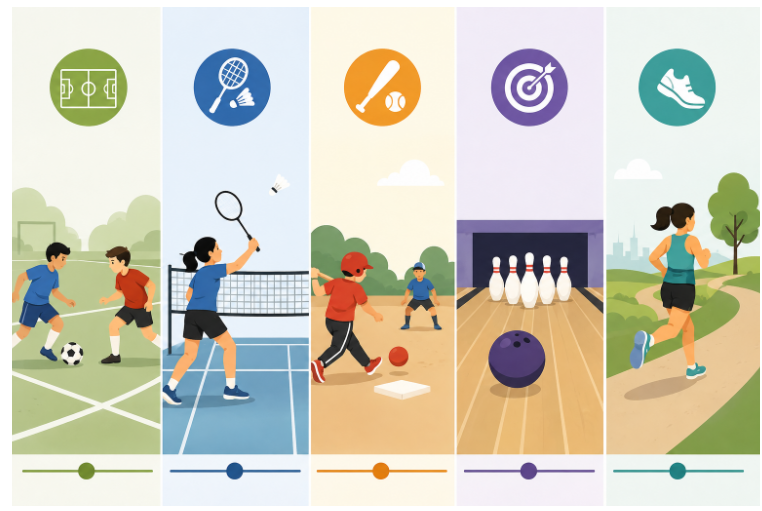
Every game category has a different structure, so it creates a different problem to solve. In invasion games, teams enter each other's territory, while net and wall games separate opponents with a net, line, or wall. Striking and fielding games involve one side sending a ball into play and the other retrieving it, while target games focus on aiming toward a target. Individual pursuits such as running, swimming, cycling, climbing, and fitness training also need strategies. Pacing, effort, timing, technique, and goals all require decisions.
Invasion Games: Find It, Keep It, Recover
Imagine a soccer match where everyone runs toward the ball like it has announced free pizza. Suddenly there is no space, passing becomes difficult, and the game turns into a crowd with shin guards. Soccer, basketball, hockey, football, and ultimate are invasion games because players attack territory while protecting their own. Their tactics often focus on defending open space, controlling possession, and recovering when possession is lost. Players therefore need to notice both where the ball is and where useful space is appearing.
Suppose your team loses the ball near the opponent's goal. Do you stand there and admire the mistake, or quickly move back to defend? Recovery means reorganizing so the other team cannot easily use the space you left behind. Possession control might mean making a safe pass instead of forcing a difficult shot. Invasion games therefore reward players who can move, support, defend, and recover.
Net and Wall Games: Protect Your Space
Now switch to badminton. Your opponent is standing close to the net, so hitting the shuttle straight back to them may be convenient for both of you, but not very strategic. Sending it toward the back corner could make them move and create space for your next shot. In badminton, tennis, volleyball, pickleball, and squash, players try to control rallies while covering and protecting open space. The tactical problem changes because opponents are usually separated rather than fighting for possession of the same object.
Rally control means thinking about placement, speed, timing, and changing the type of shot. After sending the object, you also need to recover to a useful position instead of remaining where you hit it. Ask yourself, "Which part of my court is now exposed?" A smart player attacks open space on the opponent's side while protecting open space on their own. Positioning can matter just as much as hitting.
Striking and Fielding: Look Before You Launch
During kickball, you notice most fielders standing on the left side. You could kick directly toward them with superhero confidence, or you could use the open space on the right. Baseball, softball, cricket, and kickball are striking and fielding games where tactics include placing the ball into open space, avoiding outs, scoring runs, and preventing runs. Attackers decide where to send the ball and whether advancing is worth the risk. Fielders predict where it may go and organize themselves to stop runners from scoring.
Target Games: Accuracy Beats Chaos
Target games may seem quieter, but decisions still matter. In bowling, curling, golf, archery, and bocce, players think about target accuracy, obstacles, force, direction, and sometimes the order of shots. Imagine a bocce ball blocking the easiest route to the target. You might attempt a risky shot around it, use a safer path, or place your ball somewhere useful for the next turn. Here, the structure rewards control and planning more than chasing space or maintaining possession.
So, What Actually Transfers?
Basketball, badminton, kickball, and bowling have different rules, yet the thinking process follows a familiar pattern. You observe the situation, identify the problem, choose an option, move, and adjust after seeing the result. In basketball you may protect open space, while in badminton you protect open court; in kickball you attack a gap, while in bowling you adjust your path toward a target. Individual activities use the same process, such as a runner deciding when to conserve energy and when to speed up. Tactical thinking transfers even when the exact tactic changes.
Try the Four Game Challenge
The next time you participate in physical activity, do not only ask whether you performed the skill correctly. Ask what problem the activity is giving you and why one choice might work better than another. In an invasion game, notice possession and open space; in a net game, watch court coverage; in a striking game, look for gaps and running opportunities; and in a target game, consider accuracy and obstacles. Then compare those decisions with an individual activity such as swimming or running. Different games may ask different questions, but becoming a stronger participant means learning how to read them and choose your answer.
Quick Comparison Check
Invasion: How can I keep possession, defend space, or recover?
Net and wall: How can I control the rally and protect my court?
Striking and fielding: Where can I place the ball, score, or prevent a run?
Target: How can I improve accuracy, manage an obstacle, or use shot order?