
When Everyone Gets to Be Part of the Game
A game can have ten people on the court and still really be played by four.
You have probably seen some version of it. A few people get most of the passes, make most of the decisions and seem to be involved in everything. Someone else has barely touched the ball, another person is hanging around the edge of the play, and eventually someone stops trying very hard to get involved at all.
Nobody necessarily announced, “You are not part of this.” It can happen much more quietly than that.
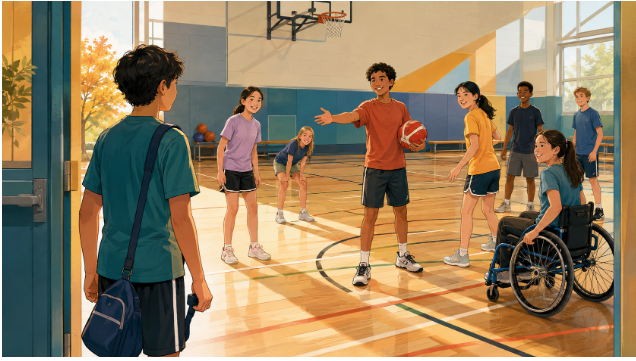
Being There Is Not the Same as Being Included
Inclusion means more than allowing everyone to join the activity. It means creating a reasonable opportunity for people to participate, contribute and feel that what they bring matters.
That does not require everyone to have the same skills or do exactly the same thing. People arrive with different abilities, experience, confidence, interests and strengths. An inclusive group figures out how to work with those differences instead of treating them as a problem.
That might mean noticing that someone is a strong communicator even if they are still learning the physical skills. Someone else might be good at organizing, encouraging people, demonstrating a movement or seeing what is happening across the whole game. Giving people meaningful roles based on their strengths can make the entire group work better.
Sometimes the Game Needs to Change
There is an interesting thing about rules. We usually think the players have to adapt to the rules, but sometimes changing a rule makes the activity better for the people playing it.
Suppose three experienced players keep controlling the ball. A group could create a rule requiring several different people to receive a pass before a team can score. You have not made anyone less capable. You have changed the conditions so that more people have a reason and an opportunity to become involved.
The same idea can work by changing team size, equipment, playing space, roles or how points are earned. The purpose is not to make everything easy. A good modification keeps enough challenge to make the activity interesting while removing something that is unnecessarily keeping people on the outside.
You Affect the Game Too
Rules and roles matter, but so do the hundreds of tiny interactions happening while people play.
Passing to someone who has not had the ball matters. So does encouraging someone after a mistake, listening when another person suggests a strategy, inviting someone into a group and speaking up when someone is repeatedly being left out. Empathy helps because it asks you to notice what the activity might feel like from somebody else's position, not just your own.
Respecting diversity is part of this too. People can differ in physical ability, coordination, experience, culture, communication style, confidence and plenty of other ways. Inclusion does not ask us to pretend those differences do not exist. It asks us to recognize that different people can bring different strengths and still belong in the same activity.
There Is Another Reason This Matters
Feeling included can change how an activity feels.
When people feel supported and connected to others, participation can become more enjoyable and meaningful. Encouragement and social support are also associated with physical activity among adolescents. In other words, the people around us can influence whether being active feels like something we want to keep doing.
The opposite can happen too. If every game repeatedly tells someone, without anyone actually saying it, that they are not very useful here, stepping back begins to make sense. Eventually, “I don't really like this activity” can sometimes have less to do with the activity than with the experience that came with it.
That is why inclusion is not just something a teacher creates. Everyone in the group helps create the experience everyone else is having.
A pass can do it. An encouraging comment can do it. Changing a rule, finding a role that uses someone's strengths or noticing the person who has barely been involved can do it.
And sometimes helping another person find a place in the game is exactly what helps them want to come back to it.