
What Can You Bring to the Team?
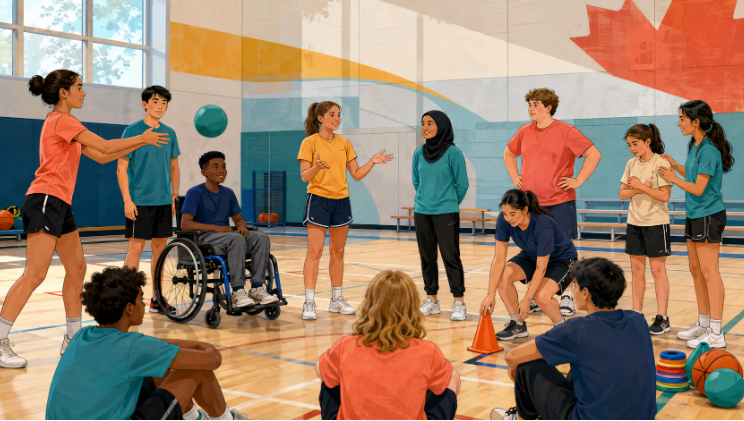
A group is getting ready for a physical activity.
Within seconds, the fastest person becomes captain. The most experienced player demonstrates the activity. Everyone else is told to “just find a position.” That may feel like the obvious way to organize a team. But speed and experience are only two of the things a group might need.
Who will explain the rules clearly? Who will notice if someone is being left out? Who can stay calm if people disagree? Who will organize the equipment or encourage someone who is nervous? The best player is not automatically the best person for every responsibility.
A strong group notices what different people can bring.
Not Every Strength Appears on a Scoreboard
Some strengths in physical activity are easy to see. A person may run quickly, throw accurately, balance well or learn movements easily. Other strengths are less visible.
Someone may be good at organizing, listening or explaining. Another person may notice when a teammate is uncomfortable. Someone else may remain patient when the group becomes frustrated.
These can all be described as strengths, talents and assets. An asset is anything a person brings that can help the group. It might be experience, creativity, cultural knowledge, confidence or the ability to communicate in another language. It could even be a willingness to ask questions.
A student who asks, “Can you show us that movement again?” may discover that several other people were confused too. If a group looks only for athletic ability, it may miss many of the qualities that help an activity succeed.
Match the Strength to the Moment
Different responsibilities need different kinds of strengths.
| If someone is good at… | They might contribute by… |
|---|---|
| Explaining clearly | Introducing the rules |
| Demonstrating movements | Showing how an activity works |
| Organizing | Preparing equipment or positions |
| Staying calm | Helping during disagreements |
| Noticing other people | Checking that everyone is involved |
| Encouraging others | Supporting effort and confidence |
| Thinking creatively | Suggesting an adaptation or new strategy |
Being on the Team Is Not Always the Same as Participating
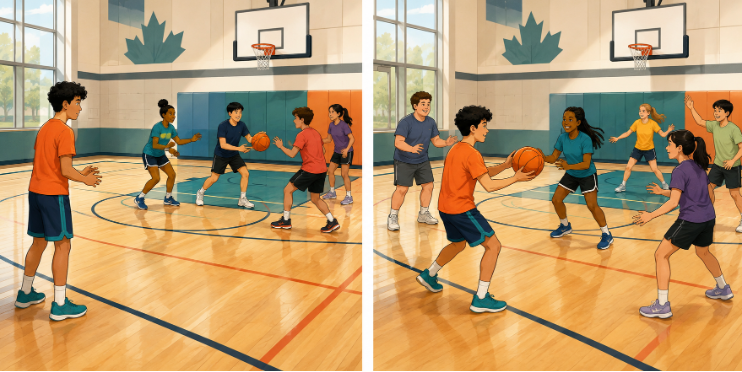
Imagine a student is invited into a basketball game but never receives the ball. They are standing on the court. Their name may even be on the team list. But are they meaningfully included? Inclusion means having a genuine opportunity to participate and contribute.
Sometimes the rules of an activity can be modified to make that possible. A group could require several passes before a team scores, rotate positions after each round or provide more than one way to earn points. Changing a rule does not automatically make the game unfair. A fair activity does not always give everyone the exact same experience. It gives people a reasonable opportunity to take part.
The change should still match the goal of the activity. If the group is practising teamwork, a rule that encourages more passing supports that goal. If the group is practising accuracy, targets could be placed at different distances.
The question is not simply, “Did everyone join?”
It is, “Did everyone have a real way to contribute?”
Encouragement That Actually Helps
“Come on, it’s easy!”
That may be intended as encouragement. It can also make someone feel worse if the activity does not feel easy to them. Useful encouragement is specific and respectful.
You might say:
“You found a good space that time.”
“Would you like to practise the pass together?”
“Your idea helped us organize the group.”
“We can slow the first round down.”
Encouragement does not mean pretending every attempt was perfect. It means helping someone recognize what they did well and what they can try next. It also means respecting the person’s choice. Some people enjoy loud cheering. Others prefer quieter support. Asking what helps is better than assuming.