
Would You Still Step In?
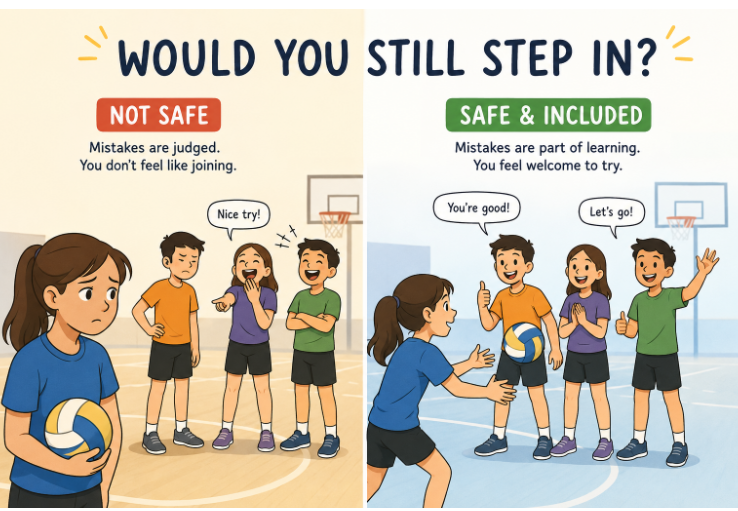
Imagine walking into gym class and hearing that today you are playing a game you have barely tried before. You miss your first pass, someone groans dramatically like you have just ruined the championship final, and another person laughs. For the next few minutes, nobody sends the ball your way, so you start moving a little less and hoping nobody notices you. The next time the ball rolls toward you, you may suddenly become very interested in tying a shoelace that was perfectly fine ten seconds ago. The game itself may not be the problem; the way people reacted around you has changed how safe it feels to participate.
Now replay the exact same moment, but change the response. You still miss the pass, because this is not a movie and nobody becomes a sports superstar in three seconds. This time a teammate says, “No worries,” the game continues, and a minute later someone passes to you again. Your skill level has not changed, the rules have not changed, and the gym has not changed, but you are much more likely to keep trying. That is the connection between participation and feeling safe and included: when people believe they can make mistakes, learn, and still belong, joining in becomes easier.
Safety Is More Than Not Getting Hurt
Physical safety is an important part of any activity. Equipment should be used properly, the space should be clear, rules should reduce unnecessary risk, and people should know how to move safely. But there is another kind of safety that can be just as important for participation: social and emotional safety. A student may be physically safe from injury but still feel nervous about being mocked, blamed, ignored, or embarrassed in front of everyone. When that happens, part of the brain is no longer focused only on learning the activity; it is also busy wondering what other people might do if something goes wrong. That extra worry can make someone quieter, more hesitant, or less willing to participate.
What Happens After the Mistake?
One of the easiest ways to understand a group's environment is to watch what happens right after somebody makes a mistake. Maybe a player misses a shot, forgets a rule, drops a ball, or finishes an activity later than everyone else. If the group complains, laughs, or stops including that person, the message is pretty clear: mistakes can cost you your place in the activity. If the group stays respectful and gives the person another real chance, the message is different: you are allowed to be learning here. A safe learning environment does not remove mistakes; it changes what mistakes mean.
Try this quick group check:
Do people get another chance after making a mistake?
Are less experienced players still passed the ball or included in a role?
Can someone ask a question without being teased?
Do teammates use respectful words even when the score is close?
Can rules or roles be adjusted so more people can participate safely?
These small behaviours connect to ideas such as inclusion, equity, etiquette, and sportsmanship. Sharing opportunities, respecting different skill levels, following fair rules, and adapting an activity when needed can make the whole group feel more welcoming. That does not mean everyone will suddenly love every activity; someone may simply prefer swimming to volleyball, or dancing to running. Feeling safe cannot create interest that is not there, but it can remove an unnecessary reason for staying on the sidelines. In other words, a good environment gives people a fair chance to decide whether they want to participate.
Become an Environment Detective
The same idea works outside physical activity too, which makes this a useful detective challenge. In a science group, notice whose ideas are heard; at lunch, notice who gets invited into the conversation; during rehearsal or club practice, notice what happens when someone is new or unsure. You are not trying to guess what everyone is thinking, because mind reading is still not part of the Grade 8 curriculum. Instead, look for patterns in what the group actually does: who gets interrupted, who gets encouraged, and who gets another opportunity after getting something wrong. Those patterns give clues about whether participating feels safe and worthwhile.
You can also point the detective lens at your own behaviour. When a new person joins, do you make space for them or keep the activity locked inside the same small group? When someone makes a mistake, does your reaction make the next attempt easier or harder? You may not control the entire class or team, but your words, facial expressions, passes, invitations, and reactions all become part of the environment other people experience. Sometimes one respectful response is enough to show someone that they are still welcome.
Run the Experiment
During your next physical activity, watch more than the score. Notice what happens when teams are chosen, when somebody misses, when a rule is questioned, when a beginner joins, and when someone who has been quiet finally tries. Then ask yourself two questions: What makes it easier for people to step in, and what makes them want to stay back? You may discover that participation is not only about confidence, talent, or motivation; it is also shaped by what people expect will happen after they join. A group that feels safe gives more people the freedom to try, learn, contribute, and participate.
So the next time someone is standing near the edge of an activity, do not assume they simply need to “try harder” or “be more confident.” Take a look at the environment they are being asked to enter. Does it offer patience, respect, fair opportunities, and room to learn, or does every mistake feel like a public performance? Whole group participation becomes more likely when people know they can join without losing their dignity the moment something goes wrong. Sometimes the best way to help someone step in is not to change the person at the edge; it is to change what happens after they enter.
Your Turn
Think of one physical activity you have done at school, with friends, or in your community. Picture a moment when someone was new, nervous, or made a mistake, and remember how the group responded. What did people do that made participation easier, and what could they have done differently? Choose one small behaviour you could use next time, such as passing to someone again, explaining a rule calmly, inviting a person into a role, or simply saying, “Keep going.” Small actions can help create the kind of environment where more people feel safe enough to take part.