
Guardians of the Ball (Not Galaxies)
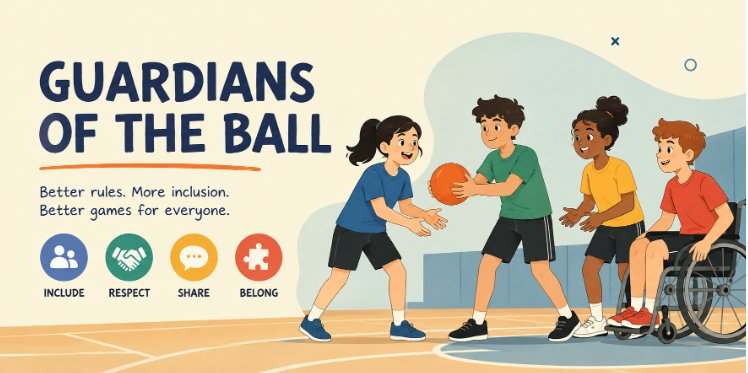
A game is going badly, although nobody is actually breaking the rules. Three players seem to touch the ball every few seconds. The ball has apparently decided that these three are its legal guardians. Two others are mostly running from one end of the gym to the other, while another player has touched the ball once, briefly. Everyone is technically playing, but not everyone is really getting much of a chance to participate
So your group comes up with a solution: every player must touch the ball before the team can score. That sounds fair. The ball likes this too, it is happier with more legal guardians. Nobody can be left out, everyone gets involved, problem solved. You restart the game feeling rather pleased with yourselves.
For about thirty seconds.
Now players are firing quick passes around simply because they have to. Someone gets the ball and immediately sends it away again. One player misses a pass and suddenly the whole team is waiting because they cannot score until that person gets another touch. A rule created to make the game more inclusive has somehow made one person the centre of attention for exactly the reason they did not want to be.
The rule was not a terrible idea. It just teaches us something important about rules: you cannot always tell whether a rule is good by reading it. You have to watch what happens when people actually use it.
That changes the first question you should ask when developing a rule. Instead of starting with, “What rule should we make?” start with “What problem are we trying to solve?” Maybe some people rarely receive the ball. Maybe teams are so large that several players barely become involved. Maybe the equipment makes an activity unnecessarily difficult for some people. Maybe the same students always choose the teams, make the decisions or take the most important roles.
Once you know the problem, you have more choices than simply adding another rule. You could change the size of the teams, the playing space, the equipment, the challenge, the roles people hold or the way people communicate. Smaller teams might create more opportunities to participate. A larger or slower ball might change what is possible. Rotating positions could prevent the same people from controlling the game every time.
Then comes a question that good problem-solvers learn to ask about their own ideas: Why might this not work?
Suppose you make the teams smaller so everyone gets more opportunities. Good idea, except perhaps one team now has two very experienced players and another has mostly beginners. Suppose you assign everyone a different role. That may work well, unless one person keeps getting a role that technically includes them but never lets them actually play. A solution can fix one problem and quietly create another one.
That is why another question matters just as much: What are we missing?
You may remember becoming an inclusion detective: looking beyond what is obvious and paying attention to what is actually happening to people. This is the next step. Once you notice a problem, you become a designer. You change something, watch what happens, and decide whether the change actually improved the experience.
That also explains why inclusion and equity are not simply about making everything identical. Two students can follow exactly the same rule and still have very different opportunities to participate. If one player has the ball twenty times and another gets it once, saying “the rules were the same for everybody” does not tell you the whole story. Fairness is not only about what the rule says. It is also about what the rule does.
Good group activities also allow people to contribute in different ways. Sometimes you work independently by making your own decisions, solving a problem or developing a skill. At other times your success depends on other people, and theirs depends partly on you. That is interdependence: people contributing different things while still working toward something together.
You can see this far beyond PE. Group projects have rules, even when nobody writes them down. Clubs, teams, games with friends and community activities all develop routines about who speaks, who decides, who gets included and whose ideas matter. Sometimes those routines work well. Sometimes everyone keeps following them simply because nobody has stopped to ask what they are actually doing.
So when you are asked to create rules or protocols for an activity, do more than invent something that sounds fair. Find the problem. Design a possible solution. Ask why it might fail. Ask what you might have missed. Then watch what happens and adjust it.
The first rule does not have to be perfect. In fact, discovering that it does not work quite the way you expected may be the most useful part.
Because developing an inclusive activity is not really about becoming excellent at making rules.
It is about becoming excellent at noticing what your rules do to people (and the ball).
