
Maybe You Haven't Found What Works for You Yet
Some people seem to have physical activity figured out. They play basketball after school, bike everywhere, go to dance, walk with friends, work out, swim or head outside without having a lengthy negotiation with themselves first. For someone else, being active regularly can feel considerably less automatic.
That difference can make it tempting to decide that some people are simply “active people” and others aren't. But regular physical activity is influenced by much more than whether you like sports or have enough willpower. Your interests, confidence, abilities, previous experiences, goals, available opportunities and even your ability to fit activity into your life can all influence what happens next.
So rather than asking, “Am I an active person?”, there may be a much more useful question:
“What helps me make physical activity happen?”
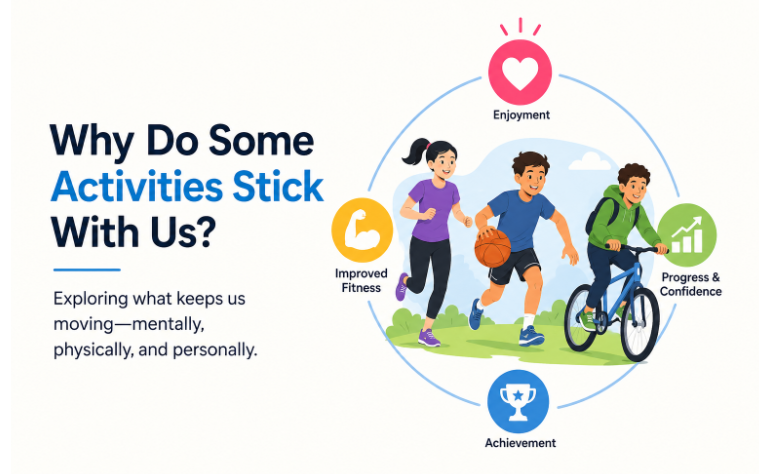
What makes you want to do something again?
Think about a physical activity you actually enjoy. It does not have to be a sport. It could be walking with someone, biking, dancing, swimming, hiking, lifting weights, skating, shooting hoops, martial arts or something else entirely.
Now think about an activity you really do not enjoy. What is different? Maybe you are better at one, like the people involved, enjoy the challenge, prefer being outside, or feel comfortable knowing what you are doing. Another activity might make you feel as though everyone else received the instruction manual several years before you arrived.
Those differences matter.
Research with young people repeatedly finds that enjoyment and confidence in their ability to participate are strongly connected with physical activity. Social support, previous experiences, opportunities and having some choice also matter.
This means reflecting on your own physical activity is not about deciding whether you have enough motivation. It is about discovering the conditions that make activity more likely to work for you.
Your first experience might not tell you very much
There is a slightly unfair feature of starting something physical.
At first, it can be hard. Your nervous system may still be learning unfamiliar movements. Your muscles are being asked to do work they may not normally do, while your heart and circulation have to deliver oxygen and nutrients to those working muscles.
Meanwhile, your brain is collecting evidence.
This is difficult.
Everyone else seems better.
My legs are complaining.
All reasonable observations.
They just might not be the end of the story.
Your body can change its answer
When you repeatedly ask your body to do something, it adapts.
Depending on the activity, your cardiovascular system can become better able to support physical work, muscles can adapt to repeated demands, and your brain and muscles can become better coordinated at movements you practise. Different activities produce different adaptations, but the important idea is simple: repeated activity can change your capacity to do that activity.
Suppose the first time you bike up a particular hill, your legs are burning and you reach the top wondering who approved hills in the first place. After riding regularly, that same hill may require a smaller proportion of what your body can now do.
The hill hasn't become smaller. You have changed. And that physical change can influence what happens psychologically.
Success gives your brain evidence
Getting through something that used to feel difficult can create a sense of achievement. It also gives your brain useful evidence.
I made it up that hill.
I can swim that distance now.
I finally learned that movement.
I kept going longer than last time.
Psychologists use the term self efficacy to describe confidence in your ability to carry out a particular action. It is not believing you are brilliant at everything or telling yourself something positive until you believe it. It develops partly from experience, especially from actually succeeding at something that once felt uncertain.
That matters because self efficacy is consistently associated with physical activity in adolescents.
The cycle now becomes easier to see. Being active can improve fitness and ability. Improving can increase confidence and a sense of achievement. Becoming more capable may make the activity feel easier and more enjoyable, which can make you more willing to participate again.
Then participating gives your body another opportunity to adapt.
Activity can help build fitness, and fitness can help make continued activity more achievable.
But knowing you can do it is only part of the problem
There is another kind of confidence that becomes important once physical activity has to compete with everything else in your life.
You might know perfectly well that you can ride your bike for thirty minutes. That does not mean the bike ride will magically appear between school, homework, dinner, friends, family responsibilities, screens, sleep and everything else competing for your time.
There are really two different questions:
Can I do this?
and
Can I make this happen in my life?
The first involves confidence in your ability.
The second involves scheduling self efficacy, which is confidence in your ability to organize physical activity within your actual life.
That difference is enormous.
“I should exercise more” is not much of a plan
A good intention can be completely genuine and still never turn into action.
I should be more active.
There is nothing wrong with that thought. The problem is that it gives your brain almost no information about what to do next.
Compare it with:
After school Thursday, I'll walk with Sam for thirty minutes.
Now there is an activity, a time and another person involved. The decision has moved closer to something you can actually do.
Planning might involve deciding what you will do, when you will do it, where it will happen and sometimes who will be involved. It can also mean thinking ahead about what could interfere.
That is not just scheduling.
It is a skill.
And skills can improve with practice.