
Building Resiliency Assets
Reviewed by Dr. Valena Wright, MD & Dr. Barry Weins, MD
There is an odd thing about resiliency. We tend to notice it when something goes wrong, but yet much of it is built when nothing particularly dramatic is happening. Things like a trusted, safe conversation in the staff room. Asking someone for another perspective when you are perhaps a little too close to something to see it clearly yourself. Going for a brisk walk to clear the mind after school instead of replaying the same frustrating moment for the seventeenth time. Choosing to start to solve one part of a problem when you cannot solve all of it. These things can look almost too ordinary to matter, but over time they become a package of resources we can draw on when life becomes less ordinary.
This is particularly useful to remember in teaching because resiliency has sometimes been described as though it belongs entirely inside a person. Be tougher. Think positively. Push through. That is not a particularly helpful way to understand it, and it certainly does not capture what we now know about resiliency. A much better understanding is that resiliency grows through the interaction between the skills and resources we carry ourselves and the people, relationships and supports that surround us. In other words, you do not have to manufacture all of this from somewhere inside yourself. Relationships matter enormously. Problem-solving matters. Knowing what is within your control, and what is not, matters. Recovery matters too, much more than we give it credit for.
And then there are those people and places where we do not have to perform as though everything is fine. I think that one deserves a little more attention. Feeling safe enough to talk, laugh, admit that something bothered you, or simply be around someone without having to explain very much can help an activated stress response begin to settle. Your mind and body finally get a little evidence that the immediate threat has passed and permission to stand down. Sometimes that may be one of the most important resiliency resources we have.
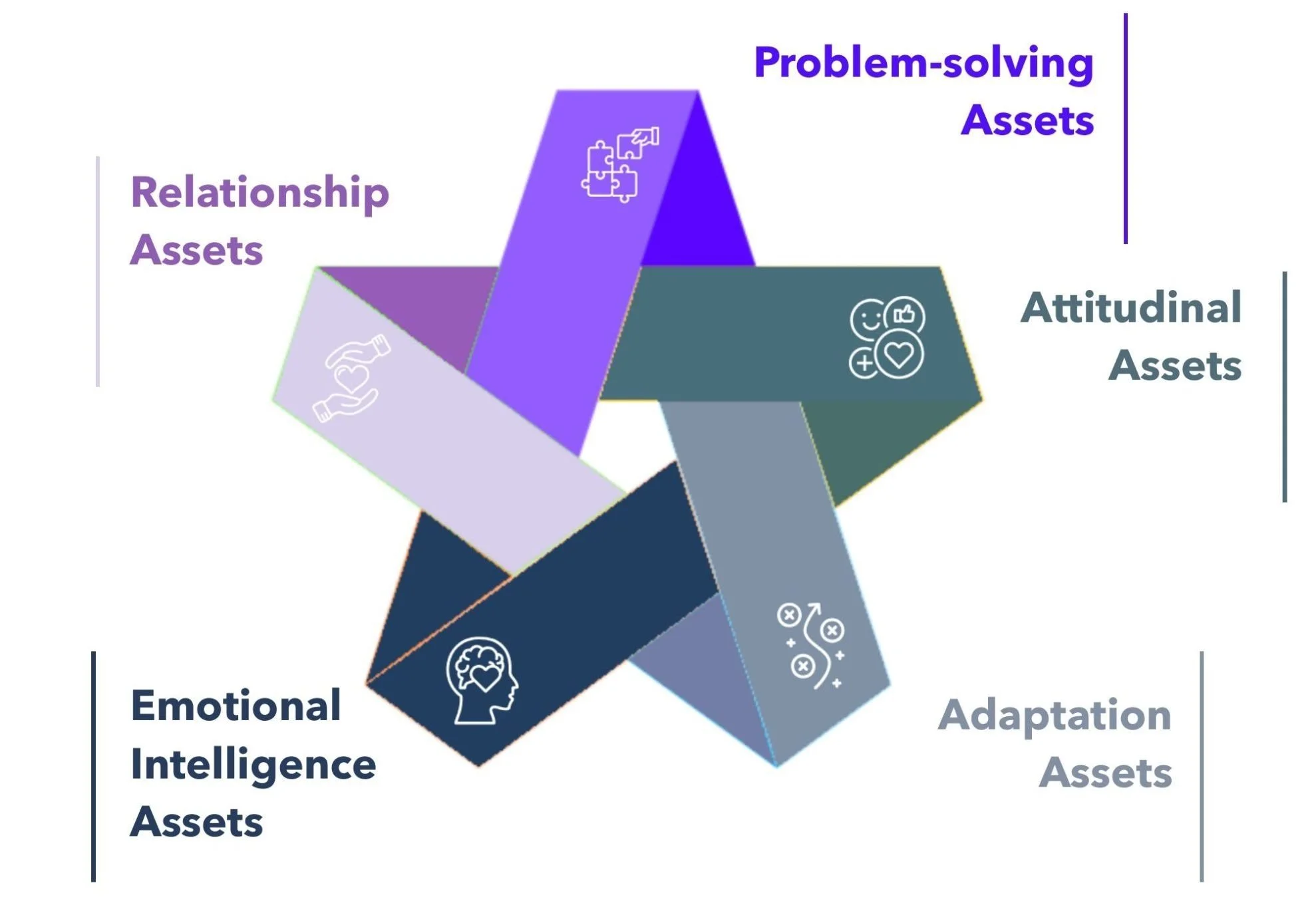
1. Start with your relationship assets
One of the strongest resiliency resources most of us have is other people. Not hundreds of people, and certainly not hundreds of social-media connections. It is that much smaller inner group who leave us feeling supported, understood, steadier, or simply a little more ourselves. Mostly, they get us.
It might be worth thinking for a moment about who those people are for you. Who is the colleague you can walk over to after a difficult class and say, “Well, that was spectacularly unsuccessful,” and know you do not need to provide the next fourteen minutes of background? Who can make you laugh at something that was decidedly not funny an hour earlier? Who helps you look at a situation differently rather than simply helping you become angrier about it? Who notices when you are struggling, perhaps before you have said very much at all? There is something very reassuring about simply knowing that person is down the hallway and understands what your day actually looked like. It can change how heavy that day feels.
But there is another side to relationship assets that we sometimes miss. Who gets some of that from you? Whose day gets a little better because you walked into it? Offering encouragement, kindness, humour, perspective, or practical help is not separate from building our own resiliency. Connection works in both directions, and being useful to someone we care about can be remarkably grounding. To share is to be trusted and to trust.
Relationships occasionally need repair as well, and a strained relationship can consume a ridiculous amount of mental space. We replay the conversation. We construct the absolutely perfect response we should have had several hours too late. We become increasingly certain about what the other person meant without actually asking them, and by the next morning we may have built a fairly elaborate story around a conversation that lasted about ninety seconds. When it is appropriate and safe, and that part is important, engaging and trying to understand another person's perspective can sometimes change the entire problem. Clarifying what happened, listening long enough to gain a deeper understanding, apologizing when that is needed, or simply having the conversation we have been avoiding can make relationship repair itself a resiliency skill. This does not mean every relationship needs to be fixed or that every disagreement should disappear. There are relationships where distance and boundaries are the healthier choice. Sometimes the win is simply refusing to allow one difficult interaction to occupy far more space in your day than it deserves.
2. When the problems start travelling as a pack
Some stressful situations feel enormous because several different problems have quietly joined together and are now travelling as a wild pack. By the time we get home it can feel as though the whole day, perhaps the whole week, is the problem. This is where one of the simplest problem-solving skills can be surprisingly useful. Pause for a moment and define what the actual problem is. Not everything surrounding it. What, specifically, needs to be addressed? Is there something here you can influence? Is there a part you cannot change today, no matter how much mental energy you throw at it?
Once the problem gets smaller and clearer, the possibilities often get a little bigger. Ask somebody else what they see. Come up with two or three options instead of convincing yourself there is only one. That is what I call being solution focused and not problem focused. The problem, it remains being, the problem. So move to being solution-focused and not problem-focused. Try the smallest reasonable next step. If that does not work, you have learned something, and that is very different from being problem-focused. There is an important resiliency asset being built underneath all of this. It is the accumulated experience of being able to say, I have been stuck before, I have possibilities, and somehow I found a way forward.
Nobody really gives us that confidence by telling us we are resilient. We earn the evidence for ourselves over time. We solve some things. We ask for help with others. We change our approach when the first attempt is clearly going nowhere. Occasionally someone standing outside the problem sees something that was almost embarrassingly obvious but completely invisible to us while we were standing in the middle of it. And sometimes we discover that we cannot impact the problem at all, but we can change how much of today's attention and energy we are going to continue giving it. None of that sounds particularly dramatic. That is probably the point. A lot of resiliency is built by simply working our way through things and discovering, afterwards, that we did.
3. Recovery is part of resiliency too
Resiliency is not the ability to remain switched on indefinitely. Our brains and bodies simply do not work that way. We need periods when demands come down and the systems that have been helping us meet those demands get an opportunity to recover. Sleep matters. Movement matters. Being outdoors can matter. Enjoyable activity, social connection, laughter and some genuine downtime matter. These are not little rewards we get once we have successfully coped with everything else. They are part of the biological pathways that open up and that allows us to cope.
This can be remarkably easy to forget in a profession built around caring for other people. There will always be another email. There is probably another lesson that could be made just a little better. Something happened with a student today that you are still thinking about, and there is that one thing you really should get finished before tomorrow. Another twenty minutes seems reasonable. Then perhaps another twenty. And somehow it is considerably later than the time you had planned to stop.
Getting away from work and actually recovering from it are also not necessarily the same thing. You can leave the building and take most of the school home with you in your head. Sometimes the best interruption to that is movement. Sometimes it is talking with someone who knows you well. Sometimes it is cooking, music, getting outside, coaching, reading, walking the dog, or doing something that has absolutely nothing to do with education. There is no perfect resiliency activity hiding here. The useful question is probably much simpler: What actually helps me come down from the day?
And occasionally the most productive thing you can do for tomorrow is stop working on today. That is not stepping away from responsibility. It is making sure you return to it with something left to give.
4. Notice the evidence you already have
There is one last resiliency asset that can be easy to overlook because we tend to remember the difficult part of an experience much more clearly than what we actually did with it. A terrible day can simply remain a terrible day. We do not need to turn it into a learning opportunity before we are allowed to go home. But somewhere around that difficult day there may also be evidence worth noticing. Perhaps you asked for help sooner than you would have a year ago. You changed an approach that was not working. You had the conversation you had been avoiding. You recovered a little more quickly. Maybe you helped someone else through their difficult moment while having one of your own.
Those things count. Over time they begin to change the internal conversation from I hope I can handle difficult things to something quieter and probably much more useful: I have been here before. I have people. I have some skills. I know a few things that help. I can probably find my way through this one too.
Most of the time, building resiliency will not feel like you are “building resiliency.” It will look far more ordinary than that. A trusted conversation in the staff room. A laugh with somebody who gets it. A brisk walk when your brain would otherwise happily replay the afternoon another seventeen times. Breaking a wild pack of problems back down to one problem you can actually do something about. Repairing a relationship when it is worth repairing. Leaving something until tomorrow because tonight you need to be finished.
And sometimes it is simply getting up the next morning and trying something a little differently. Sleeping on it sometimes helps. And give your brain permission to stand down. We build these assets in the ordinary days, often without giving them much thought at all. Then one day becomes considerably less ordinary, and there they are.