
Exam Stress, the Brain, and Why Movement Helps Students Think More Clearly
Reviewed by Dr. Peter Rawlek, MD, Dr. Barry Weins, MD and Dr. Scott Rollo, PhD
For thousands of years, most stressful situations humans encountered were deeply connected to survival. When acute stress appeared, the body had one dominant response: prepare for physical action. A threat appeared. The stress response activated. And the body prepared to do something physical. At its most basic level, survival came down to two major pathways: fight or flight.
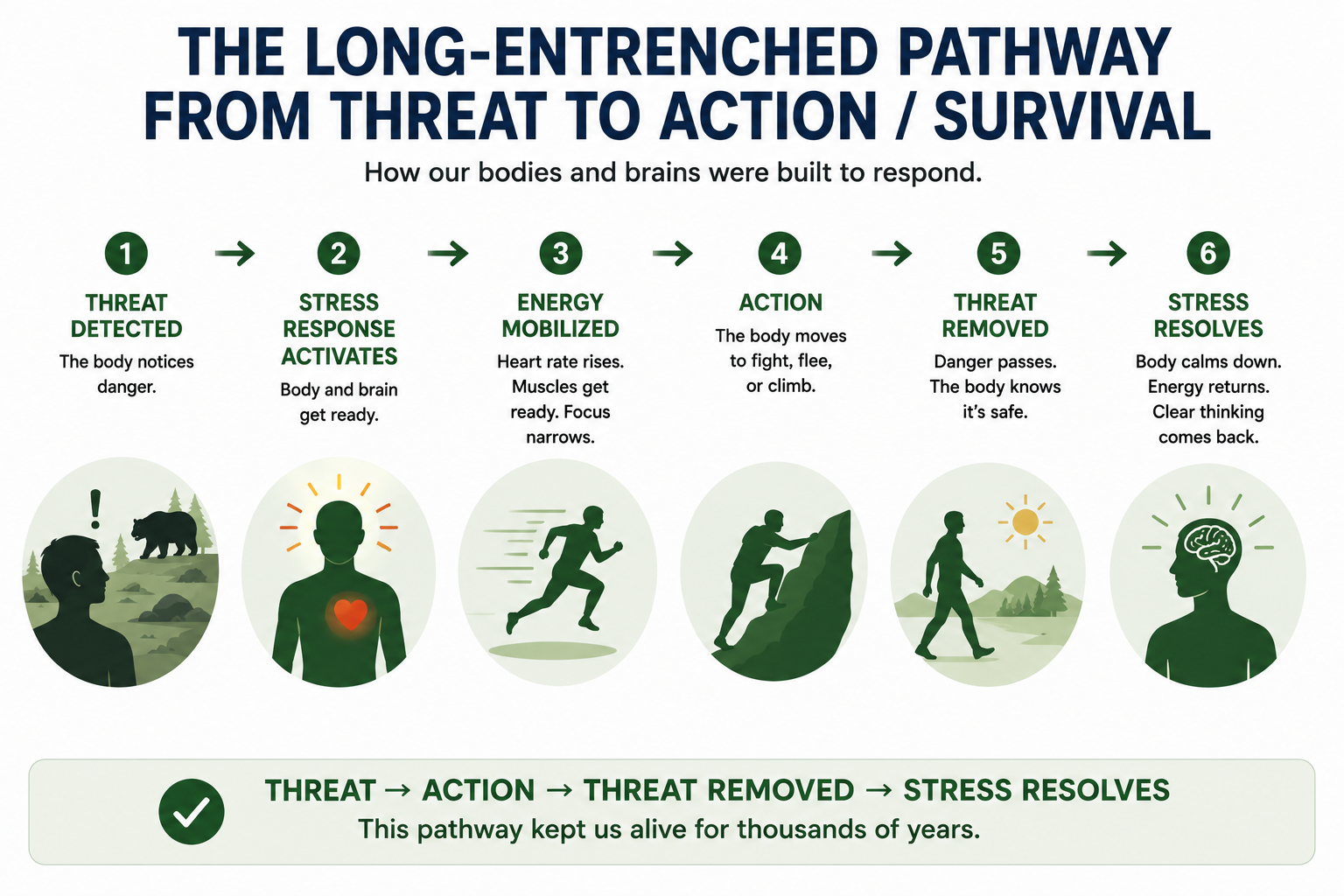
Image generated using AI guided prompts
Fight meant stand your ground and physically respond. Flight meant physically get away. Both pathways were deeply connected to movement. The stress response and physical readiness became tightly connected over thousands of years of human survival. There was no luxury for deep contemplative thinking in the middle of danger. The body had one priority: survive. And survival depended on action.
The 21st Century: Threat→ Stress→ Inaction
Today, the “threat” is often no longer physical danger outside. The threat is the exam. The assignment deadline. The work project. The presentation. The performance review. The body still activates a stress response because the brain recognizes pressure, uncertainty, importance, and consequence.
To the nervous system, stress is stress. But there is an important difference. There is no physical fight. There is no physical flight. There is only a student sitting at a desk trying to study with a degree of stress.
This creates a major biological mismatch. An old hard wired survival system becomes activated while the student is trying to perform prolonged contemplative thinking, concentration, memory retrieval, emotional regulation, and thoughtful expression sitting still for hours at a time.
The deeper issue is this: the stress response was never historically designed to optimize deep contemplative thinking. It was designed to optimize survival. As stress activation rises, the nervous system increasingly shifts toward survival readiness. Historically, that made perfect sense. The body prepared to act.
This is why prolonged unaddressed stress can begin interfering with the brain functions students need most. Attention narrows. Frustration grows. Thinking becomes harder. Students often say:
“I studied, but my mind went blank.”
“I know the material, but I can’t think clearly.”
“My brain feels scattered.”
The brain is not failing. The nervous system is carrying a growing stress load while the student is trying to force prolonged thinking on top of it.
A Personal Story
I competed internationally for several years on the Canadian team. Under the stress of competition, the response was physical. Dig deeper. Push harder. Act. The stress response and physical movement worked in tandem.
Acute Situational Stress → Stress Response → Survival
(Threat → Stress → Action)
Then I returned to university. The stress of studying, exams, and deadlines, were the new stress but now instead of physically responding, I was sitting for hours studying. Guess what happened? Every hour or two I found myself getting up, walking, moving, exercising, and physically distracting myself before returning to study again.
At that time, I did not appreciate what was happening underneath the surface. Looking back now through both a healthcare and behavioural lens, it makes much more sense. The nervous system was activating deeply rooted pathways historically associated with action. What I thought was “getting distracted” was actually helping regulate a hard wired biological system that had been activated and reinforced underneath the surface.
Exercise Snacks
This is where exercise snacks become extremely important. Students and parents need to know this. The goal is not eliminating stress. Some stress activation is normal, important, and even performance enhancing. Alertness, motivation, readiness, and focus all depend on some activation of the nervous system. The challenge occurs when stress activation increasingly overtakes the very brain functions students need most for learning, memory retrieval, concentration, emotional regulation, and thoughtful performance.
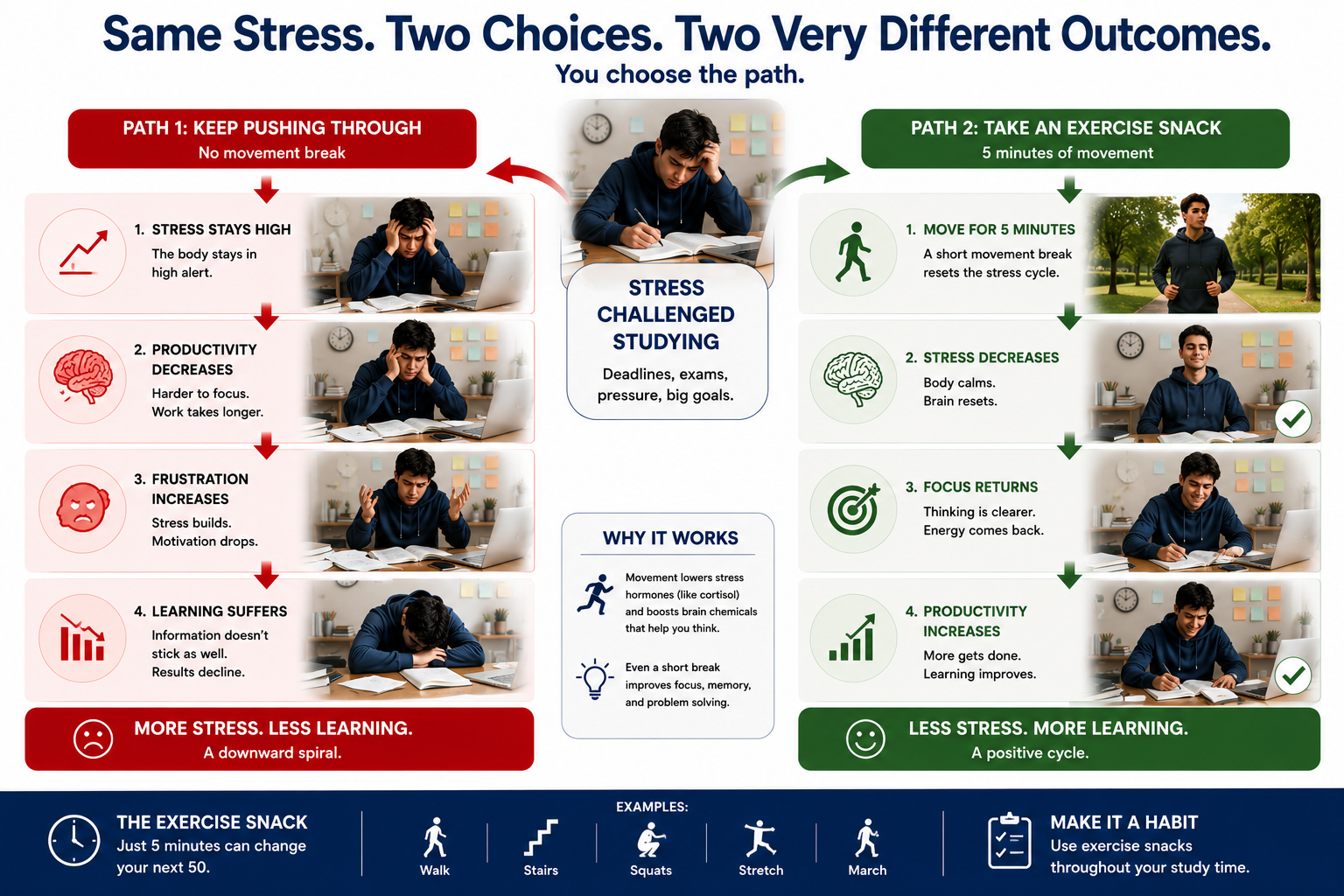
Image generated using AI guided prompts
A short exercise snack changes that biology. Readies one for learning. The movement provides the action pathway the nervous system was historically preparing for when stress activation occurred. Instead of stress continuing to build while the student sits still, the body now receives a physical action signal that helps keep stress from gradually increasing and overtaking cognition.
But something else important happens at the same time. The movement itself refreshes and reloads the brain. Blood flow increases. Alertness improves. Attention sharpens. Students return calmer, clearer, more focused, and mentally refreshed for the next period of study.
This is the important distinction. Exercise snacks are not simply “burning off stress.” They are helping support the biology underneath learning itself. They help prevent stress from becoming increasingly invasive to thinking while simultaneously refreshing and reenergizing the brain for the next bout of learning and performance.
What To Do
When students are studying for long periods under growing stress, short planned exercise snacks become extremely important. Not simply “taking a break,” but intentionally moving. A brisk walk. Stairs. Squats. Stretching. Marching. Five to ten minutes of movement every 1.5 to 2 hours can help regulate the stress response while refreshing the brain for renewed concentration and learning.
The movement is not taking away from studying. The movement is helping support the biology underneath studying. The body is not working against the student. The body is responding through systems shaped over thousands of years of human survival. Once parents and students begin understanding this, many things suddenly make more sense: the restlessness during studying, the mental fatigue after long sedentary work periods, the difficulty concentrating under pressure, and the clarity that often returns after even a short period of movement.
The opportunity at home is helping students learn how to work with that biology rather than against it.