
What is the Gut Microbiome?
Reviewed by Dr. Peter Rawlek, MD, Dr. Valena Wright, MD and Dr. Scott Rollo, PhD
The gut microbiome is the collection of microorganisms, mainly bacteria, that live in your digestive system, especially in the large intestine. They are important (See the link Your Gut Microbiome: What you need to know and Why it’s important).
You carry trillions of these organisms. Together, they function like an additional body system. They are not just present, they are active participants in how your body regulates energy, maintains internal balance, and communicates between systems.
What Do They Do?
Your body cannot fully digest fibre. That is important for your body health, because then it feeds your health-promoting bacteria. You need healthy gut bacteria (your gut microbiome).
Here is how it works:
When fibre reaches the large intestine, bacteria break it down in a process called fermentation. During this process, they produce important small molecules that are absorbed into the body and act as signals.
These signals among many jobs they do, influence/control:
how your body uses and stores energy
how your digestive system functions
how your brain and gut communicate
how the body maintains balance under stress
This is not just digestion. It is regulation across multiple systems.
Why the Gut Lining Matters
The inside of your intestine is lined with tightly connected cells. These cells form a barrier that controls what enters your bloodstream. A healthy microbiome (healthy fiber-fed bacteria) helps maintain this barrier by supporting the connections between these cells.
When this system is working well:
nutrients are absorbed properly
unwanted substances are limited
the system remains controlled
When the system is not well supported, when healthy gut bacteria are not being fed properly, the balance begins to shift. The unhealthy bacteria start to get the upper hand, and this begins to affect the strength of the gut lining. That lining is meant to act as a controlled barrier. When it becomes less effective, often referred to as “leaky gut,” the body now has to deal with things leaking from the gut into the bloodstream that were never meant to be there.
The result is inflammatory stress. The body is now working harder in the background, trying to manage and protect itself. Over time, that stress does not fully settle, and the system stays more activated than it should. And this is where it matters. That ongoing inflammatory stress can begin to influence how the body functions, contributing to changes linked to heart health, brain function, and even mental health, including mood and anxiety.
Healthy gut: strong barrier, controlled system.
Unhealthy gut: weakened barrier, persistent on-going inflammatory stress.
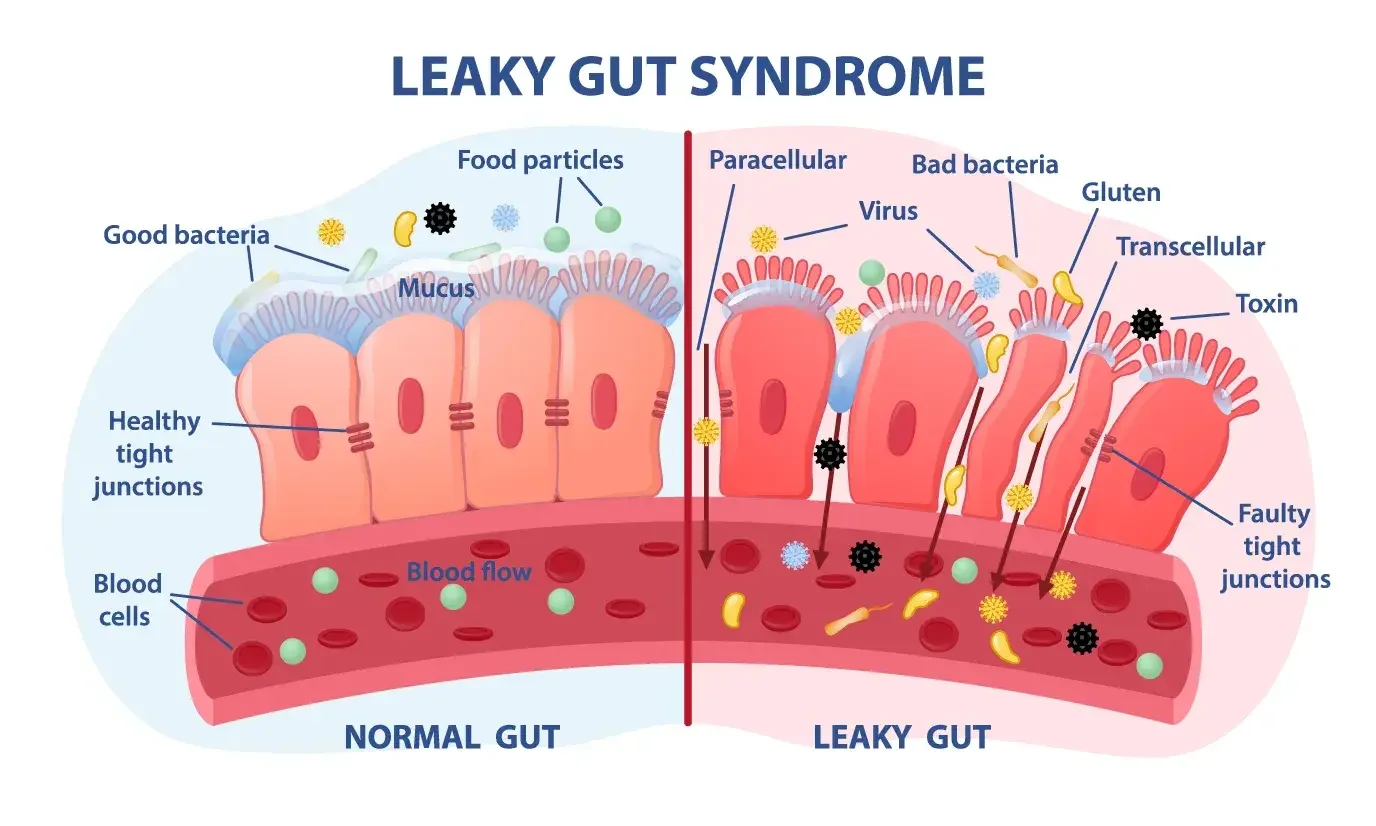
Reference: healthy gut vs unhealthy gut.
The Gut–Brain Connection
This is where it gets really interesting. Your gut and brain are constantly communicating.
The bacteria in your gut produce signals based on what you feed them. Those signals travel through the body and influence how your brain functions. There are also direct nerve connections between the gut and the brain, so what you put in your gut is being communicated in more than one way.
These signals move through the bloodstream and along those nerve pathways, influencing:
appetite
energy levels
mood and focus
readiness to learn
This is why what you eat does not just affect digestion. It shapes how you feel, how you think, and how well you perform mentally.
Food is not just fuel for the body. It is input for the brain.
Why Fibre Is Central
Fibre is the primary fuel for many of the beneficial bacteria in your gut.
Different types of fibre support different bacterial populations. A diet that includes a variety of plant-based foods supports a more diverse microbiome, which is linked to more stable and effective system regulation.
When fibre intake is low:
bacterial diversity decreases
fewer beneficial signals are produced
the system becomes less stable over time
Simple Way to Think About It
Your microbiome is a system that helps regulate your body.
With enough fibre → it produces signals that support stability
Without enough fibre → the system becomes less effective
Final Thought
The gut microbiome is not separate from your body. It is part of how your body functions.
What you eat determines how well that system works, and over time, that shapes how your body performs, adapts, and stays in balance.
Complementary Educational Resources
Please reach out to Dr. Rawlek for grade appropriate educational resources on this and other health topics.