
You Have to Risk Being Bad at Something
There is a fairly annoying rule about becoming good at something: first, you usually have to be bad at it. Nobody picks up a guitar for the first time and accidentally becomes excellent. Your first attempt at a new trick might look less like a trick and more like an investigation into gravity. Talking to someone you do not know can produce a sentence that sounded considerably better while it was still inside your head. Almost everything you can now do well once came with some chance of getting it wrong.
That is a kind of risk. Risk simply means that you cannot be completely certain what will happen. Auditioning, trying a new activity, answering when you are not completely sure, entering a competition, creating something other people will see or attempting a harder skill all contain uncertainty. You could succeed. You could also discover that today has chosen to become educational.
That second possibility is more useful than it sounds. Suppose you attempt something difficult and it goes badly. You now have information you did not have before. Maybe you went too fast, started too late, misunderstood something, needed more practice or discovered that your brilliant plan had one small weakness: the plan. The result has shown you something.
But failure is not automatically learning. You can make exactly the same mistake twelve times and mainly become more experienced at making that mistake. Learning happens when you look at what occurred, figure out what needs to change and use that information on the next attempt. The useful Build–Measure–Learn cycle is Try → Output → Look (evaluate) → Learn → Adapt → Try again.
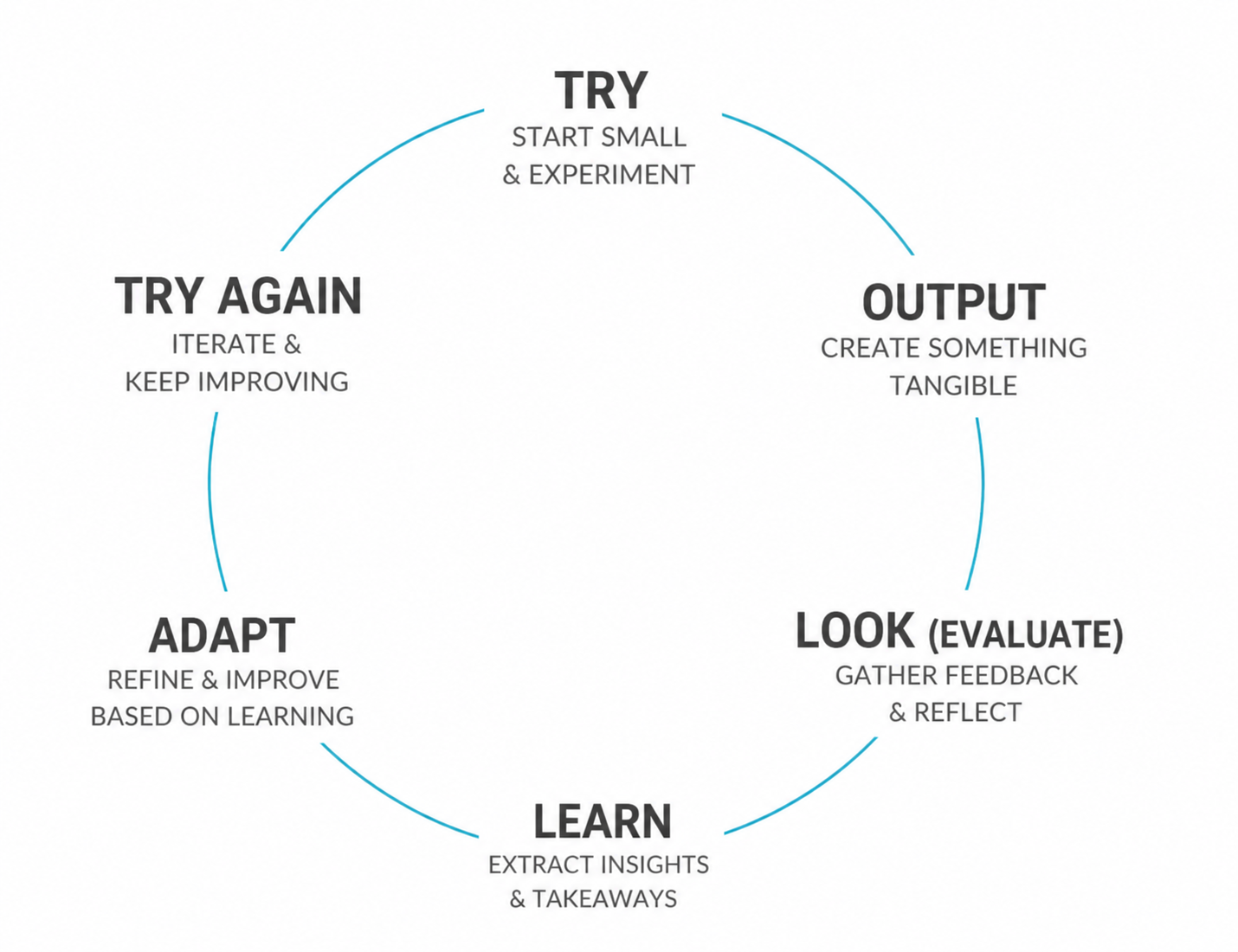
Losing can become learning, but the important part is what happens between losing and trying again.
Success belongs in the cycle too. If something works, you can still ask what worked and why. Perhaps you were better prepared, changed your technique or finally found a strategy that suited you. Then you can decide whether to repeat it or attempt something slightly harder. That is how yesterday's challenge can slowly become today's ordinary skill.
Of course, this does not mean every risk is worth taking. There is an enormous difference between risking embarrassment at an audition and risking a serious injury, getting into an unsafe vehicle or entering a situation where you could be especially vulnerable. A measured risk has been thought about. The possible benefit matters, the possible harm is considered, and you look for ways to make the situation safer before deciding.
That might mean practising first, getting better information, using the right equipment, going with someone else, telling another person where you will be, getting consent or asking a trusted adult for help. Sometimes those changes make a reasonable challenge much safer. Sometimes the possible harm remains too serious and the intelligent decision is not to proceed. Walking away from a bad risk is not the opposite of courage.
Growing up therefore requires two skills that can look almost opposite. You need enough courage to risk being unsuccessful, awkward or wrong when the consequences are manageable. You also need enough judgment to recognize when the downside is too serious to treat the situation as another learning experiment. Avoid every worthwhile risk and you miss opportunities to discover what you can do. Take every risk and, eventually, probability may request a meeting.
A measured risk does not promise success. It gives you the opportunity to act without needing a guaranteed outcome. Whatever happens next can give you information, and information can change what you do next. Try. Look. Learn. Adapt. Try again. A surprising amount of becoming capable works exactly that way.