
How Your Body Learns to Move: Exploring the Secrets of Movement
Reviewed by Dr. Scott Rollo, PhD & Dr. Peter Rawlek, MD
“Practice Makes Perfect”
For you to do any movement in a day, the movement starts in your brain and the body follows the instructions to do it. The first time you do a movement you will not do it perfectly. But, each time you repeat it, your mind and body talk back and forth and your mind improves the movement. That is really cool, isn’t it? That is where the saying, “practice makes perfect” comes from.
Even simple movements, like tapping your foot to a song, reaching up for cereal, or balancing on one leg to put on a sock all improve when repeated. Those quick, simple movements are your brain and body practicing together.
When you pay attention to movement, you will learn faster, feel steadier, and avoid getting hurt. Thinking about movement isn’t only for athletes — it’s important for everyone.
Understanding Movement
So let’s dive into “movement”.
First, we’ll look at Movement Elements—the parts that make a movement happen and help it be done well.
Next, we’ll explore Movement Concepts—the things you naturally use or notice when you move through life or play sports, often without even realizing it (you’ll find some interesting ideas here).
Finally, we’ll get into Movement Principles—the tips and strategies that help you move smarter, safer, and with less chance of slips, strains, or injuries.
Movement Elements — the building blocks of every action
Think of these as the ingredients your body uses every time you move.
1. Force — how hard or soft you move.
Example: Closing a locker gently vs. slamming it.
2. Body shape — the way your body is positioned.
Example: Stretching up to reach a top shelf vs. curling up on the couch.
3. Time & rhythm — the beat or timing of movement.
Example: Rushing to class vs. walking slowly with a friend.
4. Speed — how fast or slow you move.
Example: Sprinting in a game vs. moving slowly in yoga.
Noticing these makes it easier to control your body and try new activities.
Movement concepts — how you notice movement around you
1. Body awareness — knowing what your body parts are doing.
Example: Balancing while brushing your teeth.
2. Spatial awareness — knowing where you are in space.
Example: Walking through a busy hallway without bumping someone.
3. Effort awareness — using the right amount of energy.
Example: Opening a jar gently so nothing spills.
4. Relationships — how your movement links with others and objects.
Example: Matching your friend’s pace on a walk.
5. Quality of effort — the style or feeling of the movement.
Example: Stomping after being angry vs. floating along to music.
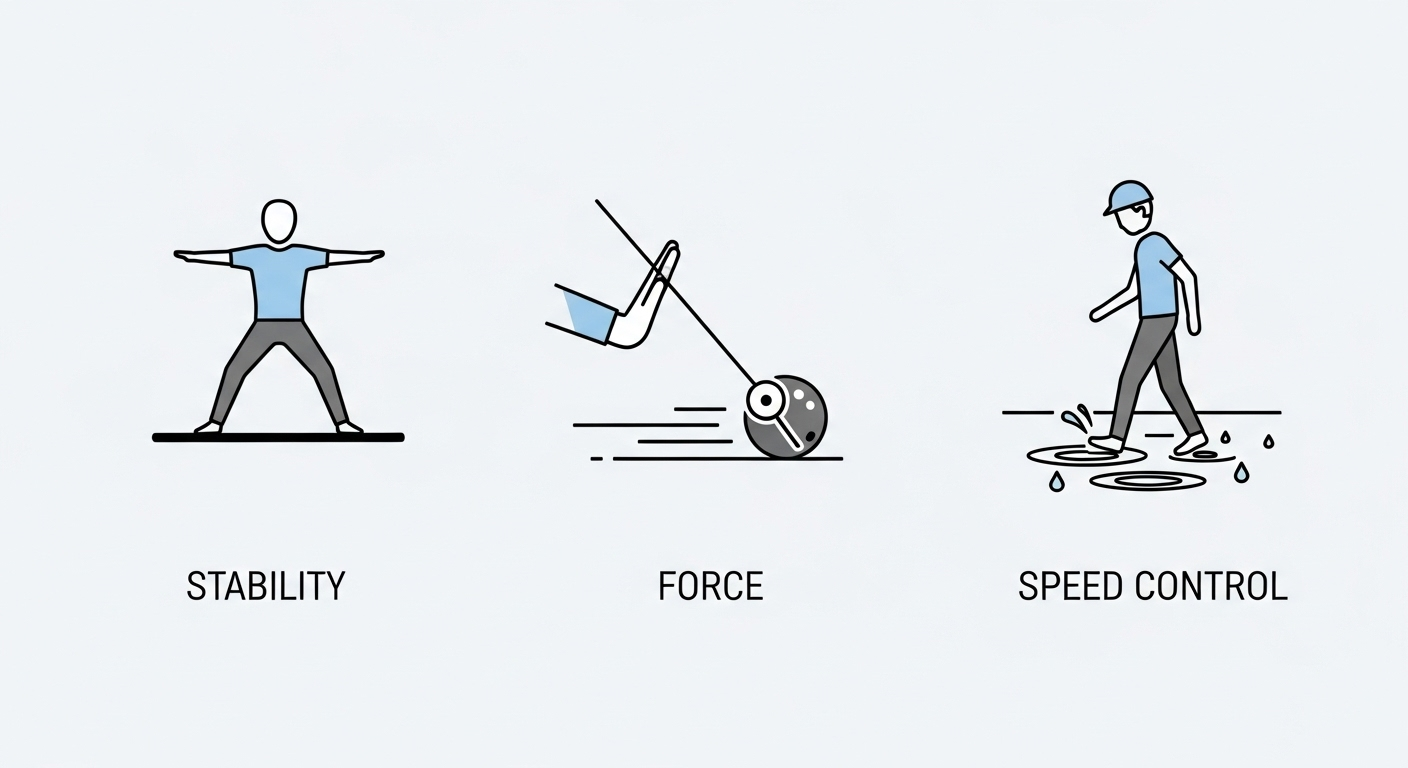
Movement principles — simple rules that keep you safe and steady
1. Stability — a wide, balanced base helps you stay up.
Tip: Bend your knees slightly before stepping off a curb.
2. Force — the right push moves you well; too much can cause loss of control.
Tip: Pump your legs on a swing — enough to go higher, not fling you out.
3. Speed control — slowing down at the right time keeps you safe.
Tip: Take smaller steps when ground is wet or uneven.
Using these ideas helps you move smarter and avoid slips or strains.
Why this matters — movement in real life
You don’t need to name these ideas while you move. But they matter when you:
carry a heavy backpack without strain
change direction quickly to avoid a fall
lift or bend safely when helping at home
feel confident joining a new game
It’s about awareness and confidence — not perfection.
Quick Student Reflection (pick 1–2)
What movement have you improved recently? What changed?
When have you felt clumsy or off-balance? What helped you fix it?
If you were teaching a friend to stretch, what one tip would you give?
How does your movement change when you feel tired or angry?
References:
Hulteen, R. M., Morgan, P. J., Barnett, L. M., Stodden, D. F., & Lubans, D. R. (2018). Development of foundational movement skills: A conceptual model for physical activity across the lifespan. Sports medicine, 48(7), 1533-1540.
Sport for Life. (2024, September). Understanding Physical Literacy: A Canadian Perspective. Sport for Life. https://sportforlife.ca/portfolio-item/understanding-physical-literacy-a-canadian-perspective/
Piotrowski, T., Makaruk, H., Tekień, E., Feleszko, W., Kołodziej, M., Albrecht, K., ... & Gąsior, J. S. (2025). Fundamental Movement/Motor Skills as an Important Component of Physical Literacy and Bridge to Physical Activity: A Scoping Review. Children, 12(10), 1406.