

Side Story: A Tale of Two Sugars
How Can Sugar From the Same Orange Have Two Different Journeys?
Sugar One arrives in a glass of orange juice. Its orange has already been squeezed and crushed. Someone picks up the glass and takes a gulp. No peeling. No chewing. No orange segments to pull apart. Sugar One appears to have hired a speeding chauffeur. Then there is Sugar Two, still at home inside the orange whole food, and so it has a few things to get through before this race even gets interesting. First, somebody has to peel the orange. Then bite it. Then chew it. Unless you have recently developed the ability to swallow oranges whole, Sugar Two has some preparation in front of it. Same kind of fruit. Same sugars. Yet one is already swallowed and in the intestine being absorbed while the other is taking its sweet time. What is so different from Sugar One to Sugar Two that sugar from the same orange has two such different journeys?
Look closer: Before reading on, what has already happened to the orange that became juice that has not happened to the whole orange?
What Did Sugar One Leave Behind?
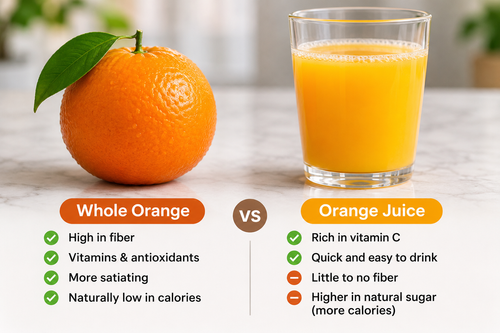
Here is the game-changer, the star of this particular story: fibre. Fibre forms much of the scaffolding that gives an orange its structure. It helps hold its sugars, water, vitamins, minerals and many of those colourful plant compounds we explored earlier together in a whole-food matrix of 1000s of packages in the whole fruit . Eat the whole orange and that natural structure is still there when you swallow it. Squeeze out the juice and most of the fibre and all of the structure are gone. Suddenly the sugar is travelling very differently. It is dissolved in liquid without most of the fibre that once surrounded it. The sugar did not change. What travelled with it did. That difference is about to become very important.
Look closer: What important part of the whole orange did Sugar One leave behind?
What Does Fibre Do to Sugar's Journey?
Here is where the two sugars really separate. Sugar Two begins inside the structure of the whole orange, which slows how quickly its sugar is released and reaches the small intestine. By the time that sugar arrives there, fibre is still travelling with it. Fibre slows and controls how quickly the sugar is released to the intestinal wall to be absorbed entering into the blood. The result is a slower, more gradual, healthy delivery of sugar. Sugar One arrives very differently, no fibre to hold it back. Juicing has removed the fibre, and what remains is the liquid fruit sugar. When that sugar reaches the small intestine, it is immediately absorbed into the blood. Sugar One rushes into the blood causing a massive sugar surge. Sugar Two arrives under the fibre's speed control.
Trace the difference: What is still travelling with Sugar Two that helps control how quickly its sugar enters the blood?
What Else Travels With the Fibre?
Remember, the whole orange is not just sugar and fibre. Its natural food matrix brings along water, vitamins, minerals and those colourful plant compounds we explored earlier. They are part of the package the orange grew with. Juicing rips away that package. Much of the fibre is gone, along with the components of the whole-food matrix, while only some vitamins, minerals and plant compounds remain in the juice. So for our two travelling sugars, fibre is the big difference we are really following . Sugar Two reaches the intestine with fibre and structure still travelling with it, helping control the sugar's absorption. Sugar One having lost most of that fibre rapidly moves into the bloodstream. Same source, a fruit. Same sugar. Different delivery systems. Very, very different journey into the blood.
Think about it: Why does removing the fibre change what happens to the orange's sugar when it reaches the intestine?
Take it with you: In one sentence, explain why sugar from a whole orange and sugar from orange juice take such different journeys to get into your blood.