

Is an Orange Just Juice That Hasn't Happened Yet?
Finding the Sugar in an Orange?
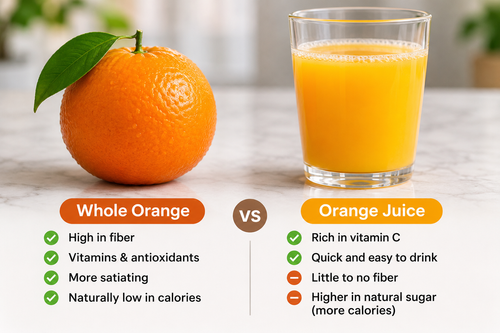
Cut open an orange. You don't find a little reservoir of orange-flavoured sugar water inside. The sugar is locked inside millions of plant cells and tiny juice-filled structures that make up the fruit. Around it is the fruit's natural matrix: packages of fibre, water, vitamins, minerals and hundreds of bioactive plant compounds. Fibre is part of the physical framework holding that package together. When you bite into a slice of the whole orange, you have to chew through that structure, and digestion has begun, your digestive tract continuing to take it apart before its sugars become available to your body. The fruit sugar does not come alone. Nature gives us the fruit's carbohydrate inside the whole fruit, wrapped together with everything else in a balanced package that controls how that sugar reaches your body.
Deconstruct the food: An orange contains fruit sugar. What else comes with that sugar when you eat the whole orange? Identify four parts of the package. Which one is an important part of the fruit's physical structure?
What Happens When We Destroy That Whole-Fruit Structure?
What happens when we destroy that whole-fruit structure and turn nature's carbohydrate into liquid fruit sugar? We squeeze the sugar and water out of the matrix and leave the whole-fruit structure behind. Juice lacks fibre, and the sugar-rich liquid from several fruits is quickly consumed and almost immediately absorbed into the blood stream. Instead of chewing through several oranges, we just swallow the carbohydrate liquid-sugar from a glass. The vitamins, minerals and bioactives that remain do not put the original fruit structure back together. Same fruit-sugar as in the whole fruit, orange, but there is no nature whole food packaging to control how how that sugar becomes available to your body. Whole fruit delivers its sugar inside its natural structure. Juice delivers fruit sugar just as a liquid.
What changed?
Three students were asked to explain what happens when a glass of orange juice enters the body.
Answers from the three:
- Student A: “It's still the same orange. We only changed its shape.”
- Student B: “The sugar is the same, so your body gets basically the same thing.”
- Student C: “The sugar may be the same, but we've removed the whole-fruit structure that controlled how that sugar was delivered.”
Question:
- Who has understood what changed?
- What would you say to the other two?
What Does Liquid Fruit Sugar Do Differently?
Once fruit sugar has been separated from the whole-fruit structure, your body has a very different thing to deal with. The liquid, swallowed. The fibre? Gone. The fruit sugar then quickly travels along the digestive system and most is absorbed all at once. Blood sugar rises rapidly. Your pancreas responds, with a comparable release of insulin attempting to move the glucose out of the blood. After a large liquid-sugar intake, that strong insulin-response is commonly followed by a substantial fall in blood sugar and then that tired, low-energy feeling people commonly recognize happens. Compare that with eating the whole fruit. Its sugar begins locked inside the fruit matrix, so eating and digestion releases it in a more controlled healthy way. Same original fruit. Very different delivery of its carbohydrate.
It’s an emergency:
Usually we want fruit sugar delivered inside the whole-fruit structure. But someone's blood sugar has now fallen dangerously low.
Question: Which would you choose now: the orange or the juice? Why?
Compare the route:
Follow the sugar in two opposing directions:
- whole orange → digestive system → blood and
- orange juice → digestive system → blood .
Where does the whole-fruit structure change what happens?
Explain why thinking that “the sugar is the same” does not tell the whole story.
When Do We Actually Want Fruit Sugar Immediately?
There actually is a time when we want sugar to reach the blood immediately. If someone develops dangerously low blood sugar, then their body needs an urgent/emergent delivery of sugar. Now readily available liquid carbohydrate becomes useful. Juice can provide sugar without the whole-fruit structure slowing its availability. In this situation, that is exactly what we want. And that reveals something important about everyday eating. Most of us are not treating dangerously low blood sugar at breakfast, after school or while watching television. We don't need to repeatedly deliver liquid-fruit sugar as though there were an emergency. The property that makes juice useful during hypoglycaemia helps us understand why keeping sugar inside the whole-fruit structure works to our advantage during ordinary eating.
Change the situation: Two people have an orange and orange juice available. One is choosing an everyday snack. The other needs immediate carbohydrate because of hypoglycaemia. Which form makes sense for each person? Use the same biology to explain why the answer changes.
Carry This Forward
The next time you compare two carbohydrate foods, don't stop when you find the carbohydrate. Ask:
What comes with it? Is the carbohydrate still inside the structure of the whole food, or has that structure been removed? What difference could that make?
That question will take you well beyond oranges.