
The Science: Why Gym Memberships Fail and Why Starting at Home Works Better
Reviewed by Dr. Barry Wiens, MD & Dr. S. Ward, MD
Every January, gym sign-ups surge. Advertisements promise fresh starts and transformation, and many people believe that paying for a membership will increase their motivation. But the research tells a very different story. Buying a gym membership as part of a New Year resolution does not improve success. In fact, it does the opposite.
Starting off with the Bottom Line
Buying the membership does not create commitment.
For most people, it deflates it.
The science is clear:
More than 70 percent of gym memberships go unused.
Nearly 80 percent of gym-attached resolutions fail within the first month.
Starting at home with small steps produces the highest early success rates.
Early success drives long-term change.
Here is the science:
1. Most gym memberships are never used

Large industry reviews have consistently shown that the majority of gym members do not attend regularly.
Key findings
The International Health, Racquet and Sportsclub Association (IHRSA) reports that more than 67 percent of membership holders never use their membership at all.
StatisticBrain and global membership analyses show similar patterns, with roughly 70 percent of memberships unused in a typical year.
This means that the average person is not “buying health.” They are buying a bill.
2. January sign-ups drop off almost immediately
Multiple studies have documented the steep early drop.
Key findings
Public health reviews note that 80 percent of New Year’s exercisers stop within five weeks.
Behaviour-tracking studies show that attendance peaks in early January and declines sharply by mid-February.
A Duke University study on motivation patterns found that momentum from a purchase does not translate into sustained behaviour.
So while the purchase feels motivating, the behaviour does not follow!
3. The brain overestimates motivation and underestimates friction
Behavioural economists describe this as the intention–action gap.

Key findings
Research from Harvard and the University of Chicago shows that people routinely overestimate how often they will use a paid resource (gyms, subscriptions, meal plans).
This optimism bias is strongest when people are feeling hopeful or recharged, such as during the New Year period.
When everyday life returns, friction increases, and attendance collapses.
The gym is not the issue. The problem is the mismatch between energy in January and the real demands of February.
4. Financial investment does not improve follow-through
A common belief is that “paying makes you committed.”
The research shows this is not true.
Key findings
A randomized controlled trial published in Behavioral Science and Policy found that financial stakes do not increase long-term exercise adherence.
Studies on prepaid vs. pay-per-use models show no difference in behaviour after the first month.
Some evidence suggests that paying for a membership can actually reduce intrinsic motivation, because the behaviour becomes tied to an obligation rather than a personal choice.
In other words,
Your bank account is not a behaviour-change tool.
5. At-home beginnings create higher early success rates
Habit science consistently supports starting where friction is lowest. This is not only true for everyday adults but also for patients recovering from serious cardiac events.
Key findings
BJ Fogg’s research at Stanford shows that small, easy, at-home actions outperform complex routines.
NHS and ACSM studies confirm that short at-home bouts of movement lead to higher early consistency.
A 2023 adherence review found that convenience and simplicity are major predictors of sustained activity.

Cardiac rehabilitation research is even more striking.
In a Canadian study of more than 1,000 cardiac patients, attendance dropped 41 percent for every 10 kilometers of distance from the rehab centre (Brual et al., 2010).
A Mayo Clinic review concluded, “Distance is one of the strongest and most consistent barriers to cardiac rehab participation.”
A global meta-analysis found that patients who live farther away are significantly less likely to start and far less likely to complete rehab programs (Supervia et al., 2019).
The lesson is clear. When you reduce friction, people show up. When you increase distance or effort, even highly motivated cardiac survivors fall away.
Starting at home is not only the simplest option. It is the option the science says works
The simpler the behaviour, the more likely it is to repeat. And repeated behaviour is the foundation of habit.
6. Identity and rhythmic scheduling support long-term adherence
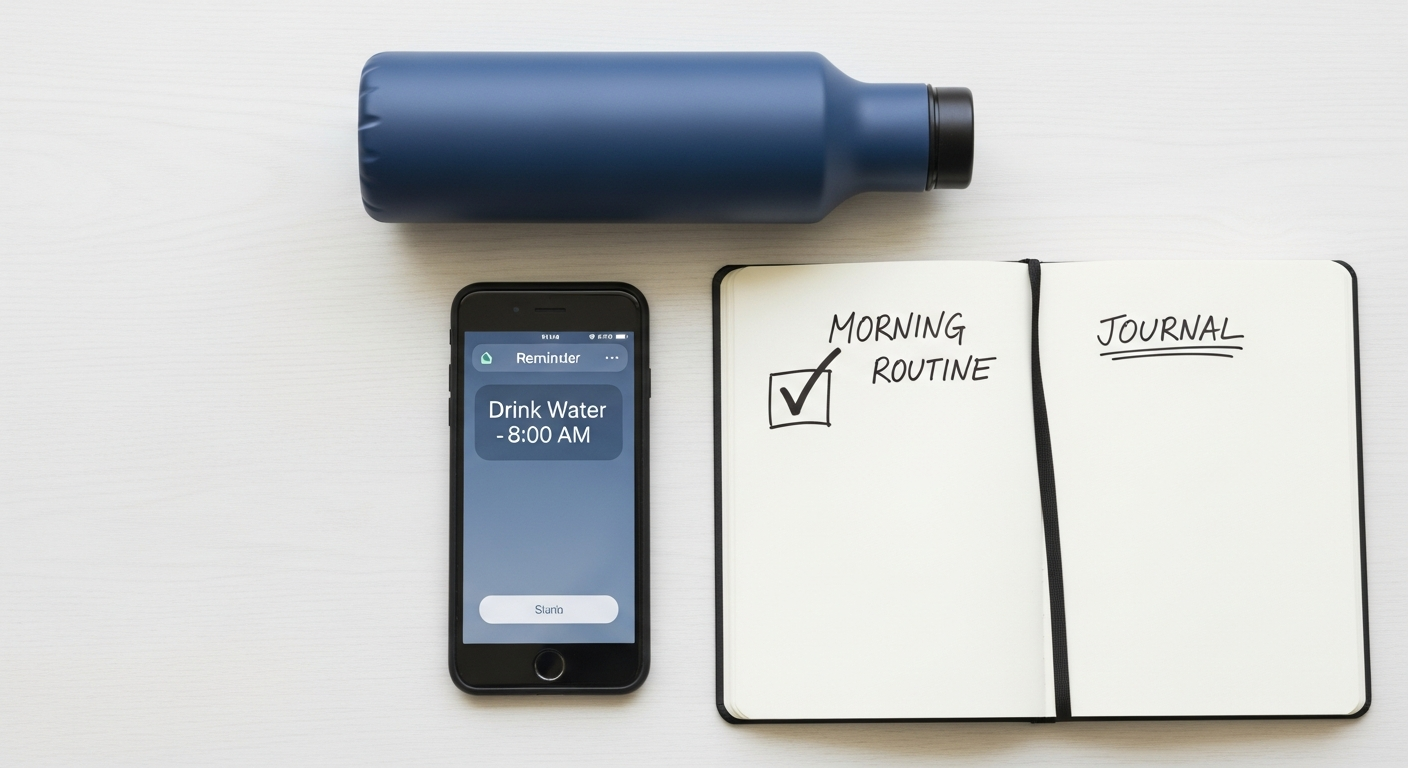
This is where the science and your companion article align.
Key findings
Identity-based goals (I am someone who moves) are far more predictive of long-term success than outcome goals (I need to lose weight).
Scheduling increases adherence because it creates implementation intentions, a concept supported by over 600 studies in behaviour-change science.
Tracking creates reward loops in the brain’s dopamine pathways, reinforcing repeat behaviour.
This is why people who start small, schedule it, and track briefly build habits that last.
7. Support from real humans changes outcomes
Social accountability is one of the most powerful behaviour-change drivers. When people believe someone is noticing their effort, their completion rates rise, their consistency improves, and they restart more quickly after inevitable disruptions.
Key findings
Studies on health coaching, micro-check-ins, and digital nudges show that supportive human contact significantly improves adherence.
Even brief, encouraging touch points from a real person can shift motivation, especially for beginners or people returning after time away.
And yes, there is an app for that.
Search GoGetFit.com and use Access Code “HABIT”.
A small shameless pitch from the author, but a behaviour-focused platform with real human recognition is exactly what the science supports
The How to Do it:
To learn how to translate this science into a practical, stick-with-it routine, read the companion article:
https://www.goget.fit/blog/7gfapiolc4pycsguh0jjeyvkkcyd6g
Reference:
American College of Sports Medicine. (n.d.). Exercise adherence and behaviour change resources. https://www.acsm.org/
Brual, J., Gravely-Witte, S., Suskin, N., Stewart, D. E., Macpherson, A., & Grace, S. L. (2010). Drive time to cardiac rehabilitation: At what point does it affect utilization? Canadian Journal of Cardiology, 26(3), e139–e143. https://doi.org/10.1016/S0828-282X(10)70372-9
Behavioral Science and Policy. (2018). Financial incentives for exercise do not improve long term adherence. https://behavioralpolicy.org/
Clinical Psychology Science. (2020). New Year’s resolutions: A two month study of adherence and motivational decline. Association for Psychological Science.
Clark, R. A., Conway, A., Poulsen, V., Keech, W., Tirimacco, R., & Tideman, P. (2015). Alternative models of cardiac rehabilitation: A systematic review. Cochrane Database of Systematic Reviews, 2015(12). https://doi.org/10.1002/14651858.CD010693.pub2
Duke University, Center for Advanced Hindsight. (n.d.). Motivation and follow through studies. https://advanced-hindsight.com/
Fogg, B. J. (2019). Tiny habits: The small changes that change everything. Houghton Mifflin Harcourt.
Ghisi, G. L. M., Grace, S. L., Thomas, S. G., & Oh, P. (2015). Barriers to cardiac rehabilitation completion in remote populations. Journal of Cardiopulmonary Rehabilitation and Prevention, 35(6), 391–398. https://doi.org/10.1097/HCR.0000000000000121
Gollwitzer, P. M. (1999). Implementation intentions: Strong effects of simple plans. American Psychologist, 54(7), 493–503. https://doi.org/10.1037/0003-066X.54.7.493
Harvard Health Publishing. (2021). Why your exercise program does not stick. Harvard Medical School. https://www.health.harvard.edu/
Harvard Kennedy School. (n.d.). The intention to action gap: Why we do not follow through on our goals. https://www.hks.harvard.edu/
International Health, Racquet and Sportsclub Association. (2023). IHRSA health club consumer report. https://www.ihrsa.org/publications/
NHS. (n.d.). Fitness Studio and physical activity guidelines. National Health Service. https://www.nhs.uk/
Rhodes, R. E., & Fiala, B. (2020). Predicting physical activity behavior: A review of key predictors and strategies for change. Health Psychology Review, 14(1), 1–17. https://doi.org/10.1080/17437199.2019.1650714
Statistic Brain Research Institute. (2021). Gym membership usage statistics. https://www.statisticbrain.com/gym-membership-statistics/
Supervia, M., Turk-Adawi, K., Lopez-Jimenez, F., et al. (2019). Cardiac rehabilitation for women: A systematic review and meta-analysis. Mayo Clinic Proceedings, 94(2), 205–226. https://doi.org/10.1016/j.mayocp.2018.08.030
University of Chicago Booth School of Business. (n.d.). Optimism bias and subscription use research. https://www.chicagobooth.edu/
Wood, W., & Rünger, D. (2016). Psychology of habit. Annual Review of Psychology, 67, 289–314. https://doi.org/10.1146/annurev-psych-122414-033417